
“Sir, we cleaned it. Phenyl and everything.” I hear this almost every time somebody calls about sanitization. And they did clean it, I believe them. Floor’s shining, whole office smells like a pine forest. Lovely. Only, shining and germ-free are two separate things, and almost everybody mixes them up.
So let me clear it up a bit. What sanitization actually means, how it’s different from disinfection and normal cleaning, where it really matters, and what you should expect when a team like ours comes to sanitize your home, office or clinic in Thiruvananthapuram.
Cleaning, sanitizing, disinfecting – aren’t they all the same?
Nope. Everybody says them like it’s one word, but it’s three separate jobs, one after the other.
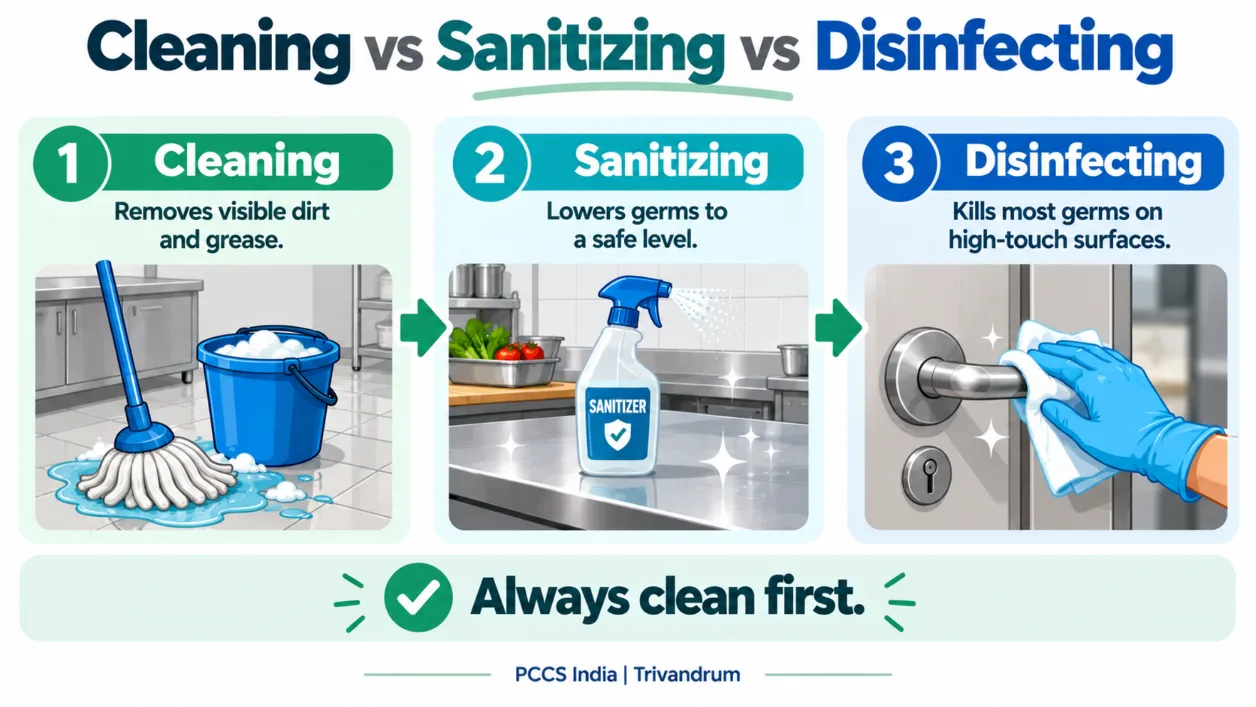
Cleaning is getting rid of the stuff your eyes can see – the dust, the crumbs, that tea stain, the oily film. Soap and water and elbow grease, basically. It won’t kill much on its own; it just carries the muck away, and some germs go along for the ride.
Sanitizing brings the number of germs on a surface down to a level that’s considered safe. Think of a restaurant table, a kitchen counter, a baby’s play area. You’re not trying to sterilise it, you just want the germ count low.
Disinfecting goes further. It uses stronger agents to kill most of the germs on a surface – bacteria and viruses – and it needs proper contact time. That’s for toilets, door handles, hospital rooms, the places a lot of hands touch, or a house where someone has been sick.
Now the part almost nobody knows. Cleaning comes first, always. If you spray disinfectant straight onto a dusty, oily table, the dirt sits there like an umbrella over the germs and they’re perfectly fine under it. That’s why, if a sanitization team skips the cleaning, I’d be asking what exactly you’re paying them for.
Where does sanitization actually matter?
Honestly, everywhere people gather or food is handled. But some places, I’d say, can’t skip it.
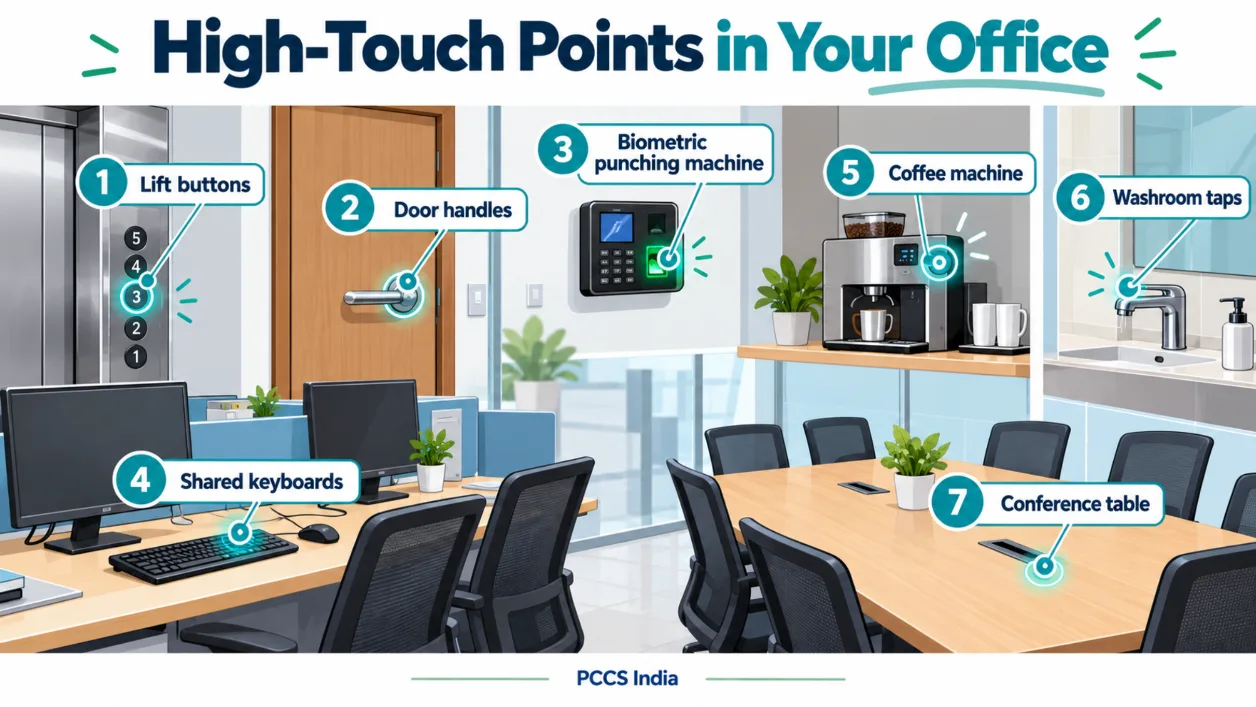
Offices, specially the shared stuff. Lift buttons, the punching machine, door handles, the coffee machine, the conference room table, keyboards in the common area. One person comes in with a cold and by Friday half the floor is sneezing. You’ve seen it.
Clinics, labs, diagnostic centres, dental clinics. Waiting areas, reception counters, the chairs, washrooms. Patients come in already sick, so this really matters.
Schools, colleges, day care centres and hostels. Kids touch everything, then their faces. Enough said.
Restaurants, bakeries, hotel kitchens, canteens – food contact surfaces, cutting boards, storage areas, the washbasins.
Gyms. Sweaty equipment, mats, changing rooms. I won’t describe what we find.
And homes. After somebody at home has had a fever, viral infection or stomach bug. After the floods – we wrote about the dangerous week after the water goes down. Before a new baby comes home. Or when Ammachi, just out of hospital, comes to stay with you for a few weeks.
What does a sanitization team actually do when they come?
For a typical office or home in Trivandrum, it goes something like this.
We walk around first and make a list of the high-touch points. Every place is different – in one office it’s the biometric machine, in another it’s the shared washroom tap that everyone complains about.
Then the cleaning, because like I said, no point disinfecting dirt. Dusting, wiping, mopping, washroom cleaning.
Then the actual sanitizing and disinfecting. We use products meant for the surface – you don’t put the same thing on a steel counter, a wooden table and a laptop keyboard. For big open areas we may use spraying or fogging equipment, and for touch points we wipe by hand, because a quick spray from two metres away doesn’t give proper coverage on a door handle.
Contact time is respected. This sounds boring but it’s the most important part. Most disinfectants need a few minutes of staying wet on the surface to work. Spray-and-wipe-immediately is mostly for show.
Finally, ventilation. We open up the place and let it air out before people use it again.
Is fogging enough to sanitize a building?
No, and I want to be clear because a lot of people got used to fogging during the Covid time. Fogging is useful for large spaces as one part of the job. It’s not a replacement for cleaning and wiping the surfaces people actually touch. A fog settles where it settles. Your door handle, your lift button, your phone – those need hands-on work.
It’s the same story as mosquito control actually. We’ve written about why fogging is not mosquito control too.
Is sanitization safe for kids and pets?
Used the right way, yes. We stick to approved products, mix them the way the label says (not “a little extra for safety”, that’s how people get headaches), and keep everyone out of the room until it’s fine. The dining table, the baby’s toys, the high chair – if the product needs rinsing off, it gets rinsed. Asthma at home? Somebody pregnant in the office? Allergies? Just tell me before, na, and we’ll work around it. One more thing, and this is important – at home, never mix bleach with toilet acid or those ammonia cleaners. It gives off a poisonous gas. People do this in tiny closed bathrooms thinking stronger is better, and end up dizzy on the floor.
How often does a place need sanitizing?
Depends on how many people use the place, more than anything.
Homes – a deep sanitization after illness, after floods, or once in a while, and regular cleaning in between. Offices – the shared touch points ideally every day by your housekeeping team, with a professional deep sanitization at intervals, maybe monthly or quarterly, and immediately if there’s an outbreak of something going around. A clinic, a lab, a hotel kitchen – those are a whole different level, a daily routine by your own people plus us coming on fixed dates.
So give us a call, describe the place, and we’ll work out something sensible. A two-chair dental clinic in Pattom and a big Technopark floor full of cubicles are obviously not getting the same plan from me.
Why choose PCCS India for sanitization in Trivandrum
We’ve been doing cleaning, sanitization and pest control in Kerala for over 15 years – homes, offices, hospitals, schools, hotels, factories. Our staff are trained on which product goes where and how long it has to stay. We bring our own equipment. We work nights and weekends so your office or clinic doesn’t have to close. And since we also do pest control, we can handle cockroaches and rats in the same visit, because honestly, no place is properly hygienic if there are pests walking over the counters at night.
You can find more on our cleaning and sanitization services page.
Sanitization FAQs
Sanitization and disinfection – what’s the difference?
Sanitizing just brings the germs down to a safe number. Disinfecting goes after nearly all of them, with stronger products left on for the right time. And for either one, you clean first.
How many hours will sanitization take?
For a house, a few hours usually. Office, that depends on the size and how many touch points we’re dealing with – we’ll give you a time once we’ve walked through.
Can you sanitize our office after working hours?
Yes, most of our office jobs are done in the evening, at night or on weekends.
Do we need to leave the house during sanitization?
Only from the rooms we’re working in, and for a bit after. Our team will tell you when you can go back.
Someone at home was sick – can you sanitize after?
Yes, that’s a common call. Just give us a rough idea what it was, fever, stomach bug, whatever, and we’ll pick the products to suit.
Book a sanitization visit
Call PCCS India on 0471-2353735 or 81138 50599, or use our contact page. Tell us whether it’s a home, office, clinic or food place and the rough size, and we’ll plan it.