
Industrial cleaning is a different animal from home cleaning. In a house, the worst you’ll find is a greasy chimney. In a factory or a warehouse, you’ve got oil on the floor that’s been walked into the concrete for two years, dust sitting on the beams twenty feet up, machines that can’t be stopped for more than a few hours, and a production manager standing behind you saying “how long, how long?”
We’ve been doing commercial and industrial cleaning in Kerala for a long time now, and I’ll say this first – the cleaning itself is not the hard part. Planning it around the work is.
So, if you’re the one running a plant, a godown, a workshop, a cashew or seafood unit, a warehouse off the NH somewhere in Kerala – this one’s for you. What all comes under industrial cleaning, how often you really need it, and how to pick someone who won’t make a mess of it.
What is industrial cleaning?
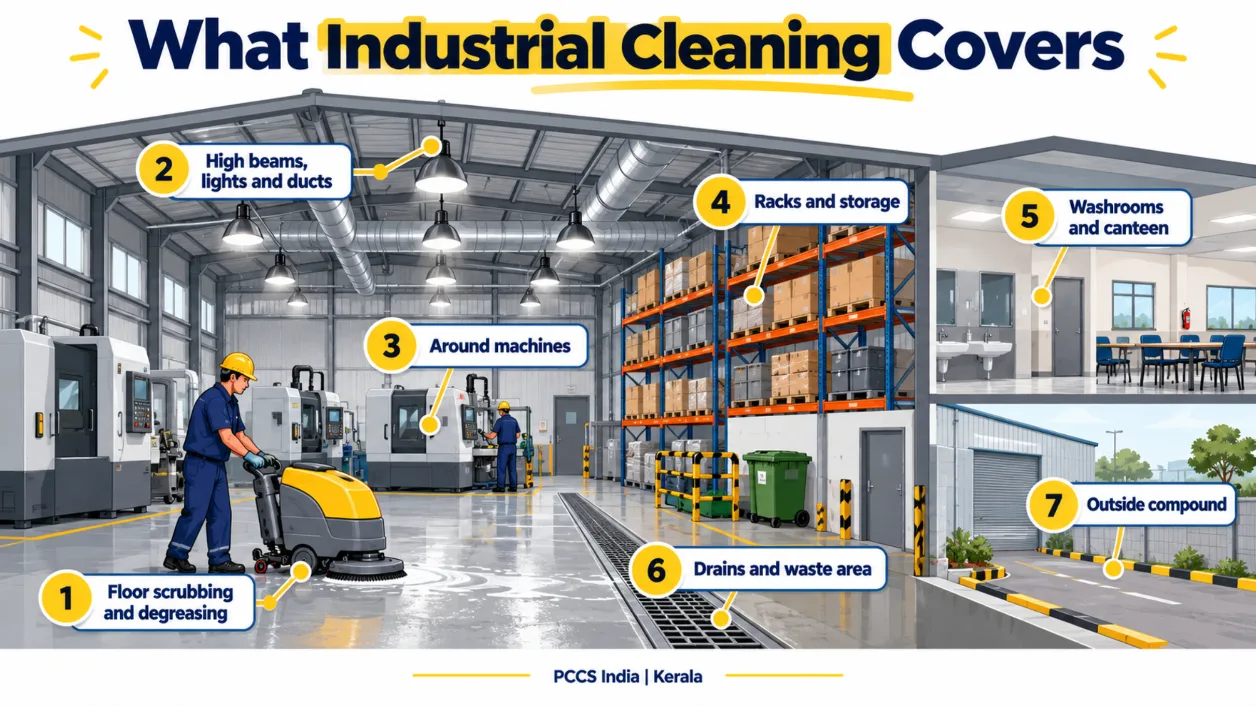
In plain words, it’s cleaning places where things get made, stored or repaired – factories, production units, godowns, workshops – where the dirt is heavier and one careless move can actually hurt someone. Floors. The outside of machines and the space around them. High stuff like roof beams, ducts and the lights hanging up there. Racks. Loading bays. Workers’ toilets and the canteen. Drains. The compound.
You can’t do that with a broom and a phenyl bottle. It’s scrubbing machines you walk behind or sit on, big vacuums, pressure washers, proper degreasers, ladders and platforms for height work. And all of it under safety rules, because there’s machinery, live electricity and sometimes chemicals right next to you.
Why does a factory need regular professional cleaning?
Not just so it looks nice for the MD’s visit, though that also.
Safety. One oily patch near the lathe and somebody’s in hospital with a broken wrist. Dust caked on the electrical panel, on the light fittings – that’s how fires start. Boxes piled in the walkway and suddenly the emergency exit is blocked. So many accidents begin with a dirty floor, really.
Machines. Dust and gunk get into the moving parts and the cooling vents, the machine runs hot, and then it’s a breakdown in the middle of an order. Clean surroundings mean fewer of those calls to the maintenance guy.
The product. Food, pharma, packaging, textiles – a bit of dust, a cockroach, some residue, and the batch is gone. Worse if it reaches a customer.
Audits. Buyer coming for a factory visit? Certification renewal? Some inspection? A clean, organised floor changes the whole mood of that meeting. Food units have their own hygiene rules on top.
Your people. Managers underestimate this one. Workers notice the toilets and the canteen. Clean ones, and people are happier, and they stay.
What does an industrial cleaning job usually cover?
No two sites are alike, which is why we always walk the floor before quoting. Usually, though, it’s something like this.
Floors. Machine scrubbing – concrete, epoxy, tiles, whatever you have. The black oil patches round the machines and in the workshop get degreased. Loading bay, yard and parking get the pressure washer.
Up high. Beams, trusses, light fittings, ducts, tops of the racks. Nobody looks up there, but that dust keeps drifting down onto everything, your finished goods included.
Around the machines. Outside surfaces, and around and under, only after the machine is stopped and locked out the way your safety team wants. Opening up or servicing the machine? No, that’s for your maintenance people.
Racks and storage. The racks themselves, the pallet area, and under that bottom shelf where dust and rats both love to collect.
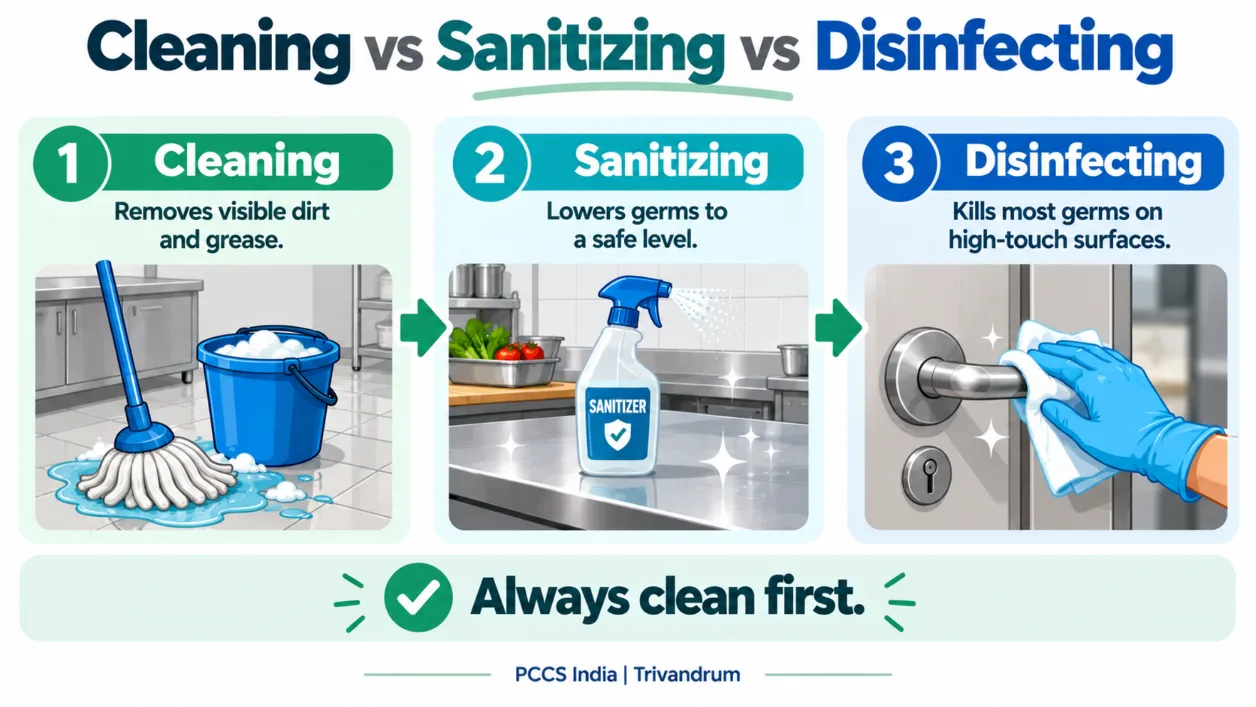
Toilets, changing rooms, canteen. Deep cleaned and sanitised.
Drains and waste. Drains cleared, the scrap yard and the waste point cleaned.
Glass. Windows, skylights, the outside of the building if you need it.
Compound. Bushes and grass cut back round the building. Helps a lot with snakes and rats too.
How do you clean without stopping production?
This is the question everybody asks first, and it’s the right question.
Bit of everything. Areas far from the line, we can often do while you’re running. Machine zones wait for a shutdown, a maintenance day, the night shift, or Sunday. Big plants we cut into sections and do over several days, one bay at a time, the rest keeps working. We sit with your production and safety people, look at the calendar together, and plan it. Your site rules apply to us like anybody else – helmets, shoes, permits, lockout, whatever you follow.
How often should industrial cleaning be done?
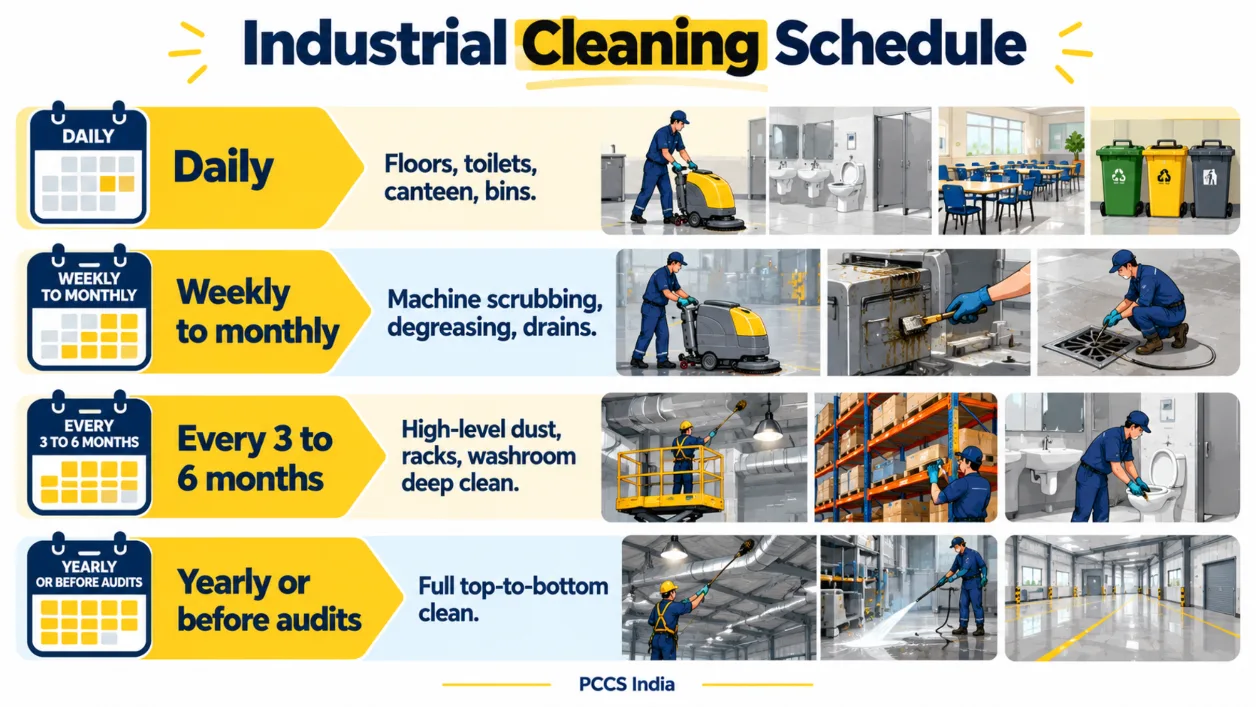
Depends on what you make, honestly. But if you want a starting point, here’s roughly what I suggest to most people.
Every day – sweeping, work areas, toilets, canteen, bins. Your own housekeeping staff can usually manage this.
Every week or month – machine scrubbing of the floor, degreasing, drains.
Every three to six months – the high-level dust, racks and storage deep clean, a proper washroom deep clean.
Once a year, or before a big audit – the full top-to-bottom.
Food and pharma? Tighter than all this.
Pest control is part of industrial hygiene
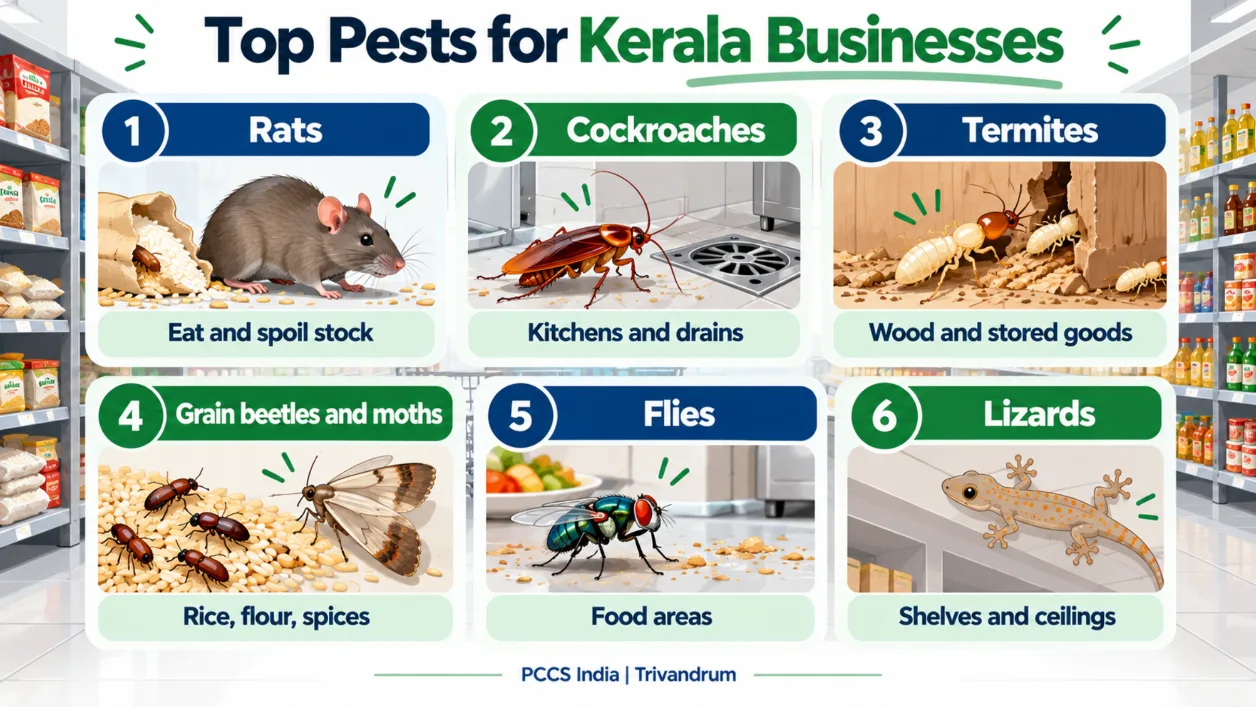
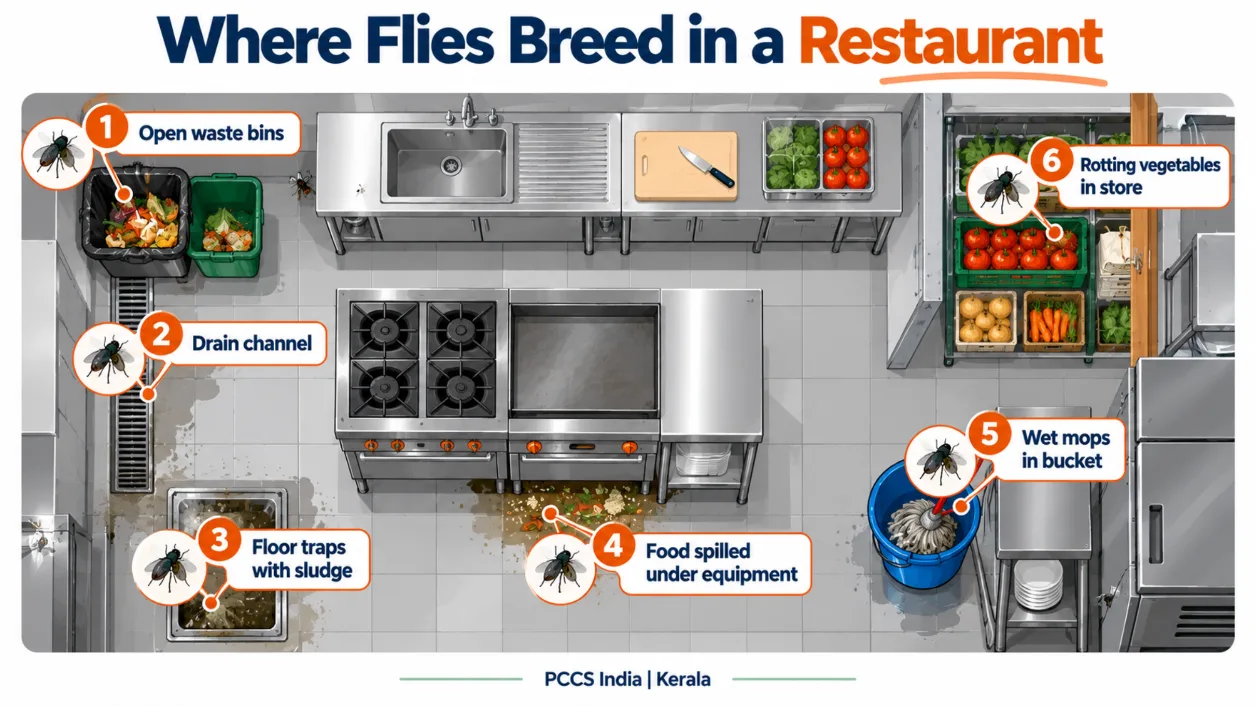
Lots of plants forget this bit. A warehouse is a rat’s dream – hiding spots everywhere, cardboard to chew, canteen leftovers. Cockroaches follow the food and the drains. Pigeons sit on the beams and you know what falls from there. Termites go for wooden pallets and whatever’s stored on them.
We happen to do pest control too, so it makes sense to club the two. Our cleaning crew goes through first, the pest team follows the same week, and after that it runs on a calendar. You deal with one company, you file one report. Your purchase department will thank you.
What to look for when hiring an industrial cleaning company
If I were sitting in your chair, I’d ask these. Did they bother coming to see the site, or did they give a number over the phone? Their own machines, or will they turn up with brooms and buckets? Are the workers trained, do they have shoes and gloves and helmets? Night shift, Sunday – okay for them? Will they follow your safety process without arguing? Any report at the end? And can they do pest control as well, so you don’t have to manage another vendor?
Why PCCS India for industrial cleaning in Kerala
We’ve been at commercial and industrial cleaning, and pest control, in Kerala for over fifteen years now. Big areas don’t scare us, we have the machines and the people. Our staff get trained before they set foot on a site. Night shifts, Sunday shutdowns, Onam holidays when the plant is empty – honestly that’s when we do our best work. Your team and ours sit together beforehand, and at the end you get a report you can actually read.
We serve industries around Thiruvananthapuram and in other districts through our branches. See more on our cleaning services page.
Industrial cleaning FAQs
What all comes under industrial cleaning?
Pretty much the full building – the floor scrubbed and degreased, the dust up on the beams, around the machines, the racks, toilets and canteen, drains, glass, even the compound. We pick from that depending on your site.
Night shift or holiday – will you come then?
That’s when we come most of the time, actually. Production keeps going, nobody’s disturbed.
Do you clean the inside of machines?
We clean the outside and the areas around machines. Anything inside the machine, leave that to your maintenance fitter or the company service engineer.
How do you decide the price?
Area, how bad the dirt is, how much height work, how often, and when. We see the site and then quote.
Plan your next plant clean
Call PCCS India on 0471-2353735 or 81138 50599, or write to us through the contact page. Tell us the type of facility and the rough area, and we’ll set up a site visit.