
You wipe the counter. Ten minutes later there’s a line of tiny ants walking from the window to the sugar tin like they own the place. You spray something from the shop, they vanish, and on Thursday they’re back. Same line, same tin. Sometimes more of them.
Sounds like your kitchen? Relax, you’re in big company. Half the ant calls that reach our office in Thiruvananthapuram open with the same line – “sir, I’ve tried everything” – and when I ask what everything means it’s the spray can, Lakshmanrekha chalk, turmeric powder, and once in a while kerosene splashed on the floor (please, please don’t do that one). It works for two days. Then it doesn’t. There’s a reason for that and it’s actually quite simple.
Why do ants keep coming back even after spraying?
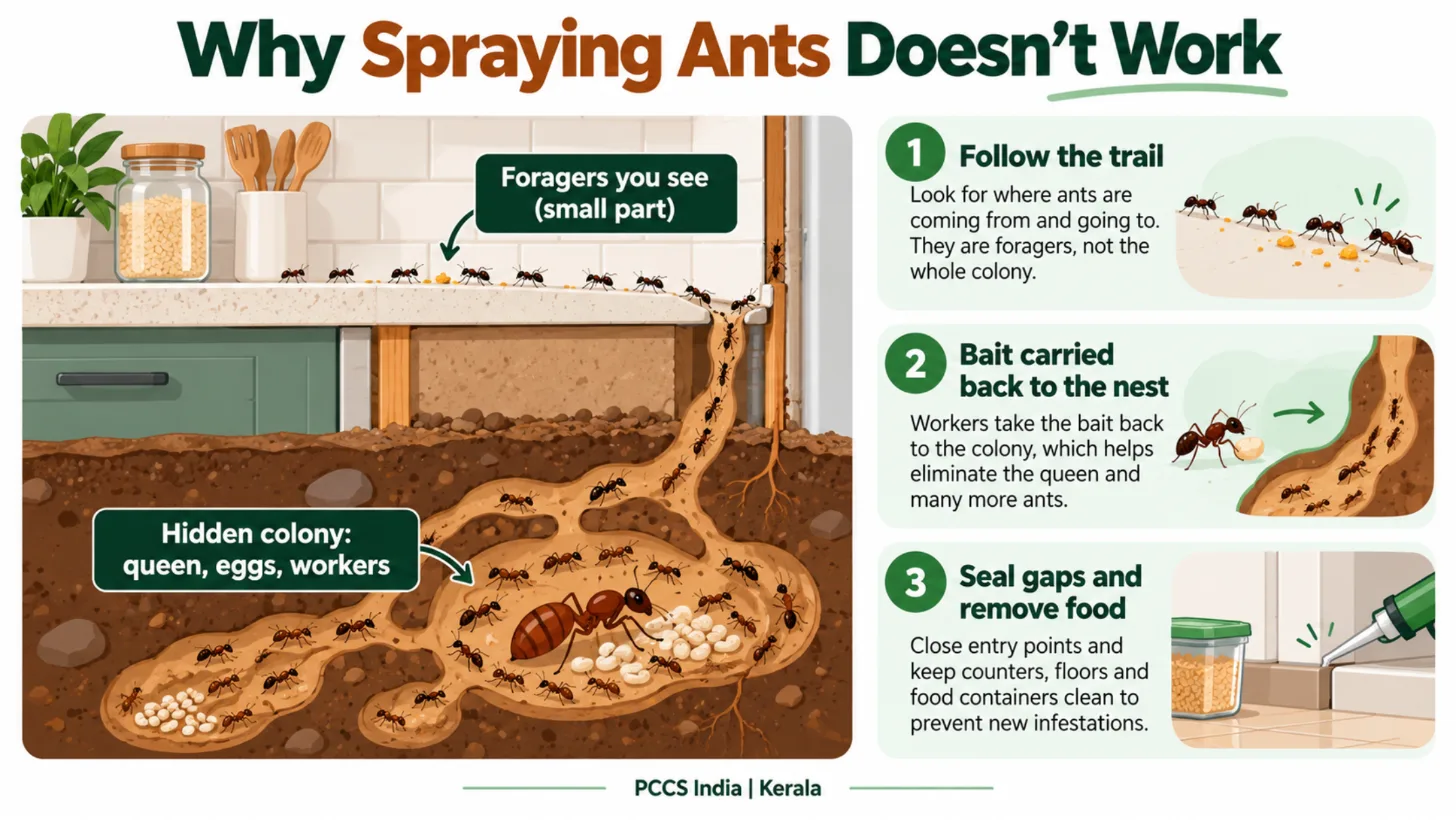
The ants on your counter? Those are just the delivery boys. The real business is somewhere else.
Most of the colony – the queen, the eggs, the young ones, thousands of workers – is sitting somewhere you can’t see. Inside a wall gap. Under a loose floor tile. In the soil next to the foundation, in a flower pot, inside the electrical box. The ones walking on your counter are foragers sent out to pick up food and carry it home. Kill them with spray and the nest simply sends out the next batch. And some ant species, when they feel attacked, actually split the colony into two or three new ones. So the spraying, in a way, can spread them.
That is the bit most people don’t know.
Which ants do we see in Kerala homes?
No biology class, promise. Still, knowing which ant you’ve got saves a lot of wasted effort, since each type plays the game its own way.
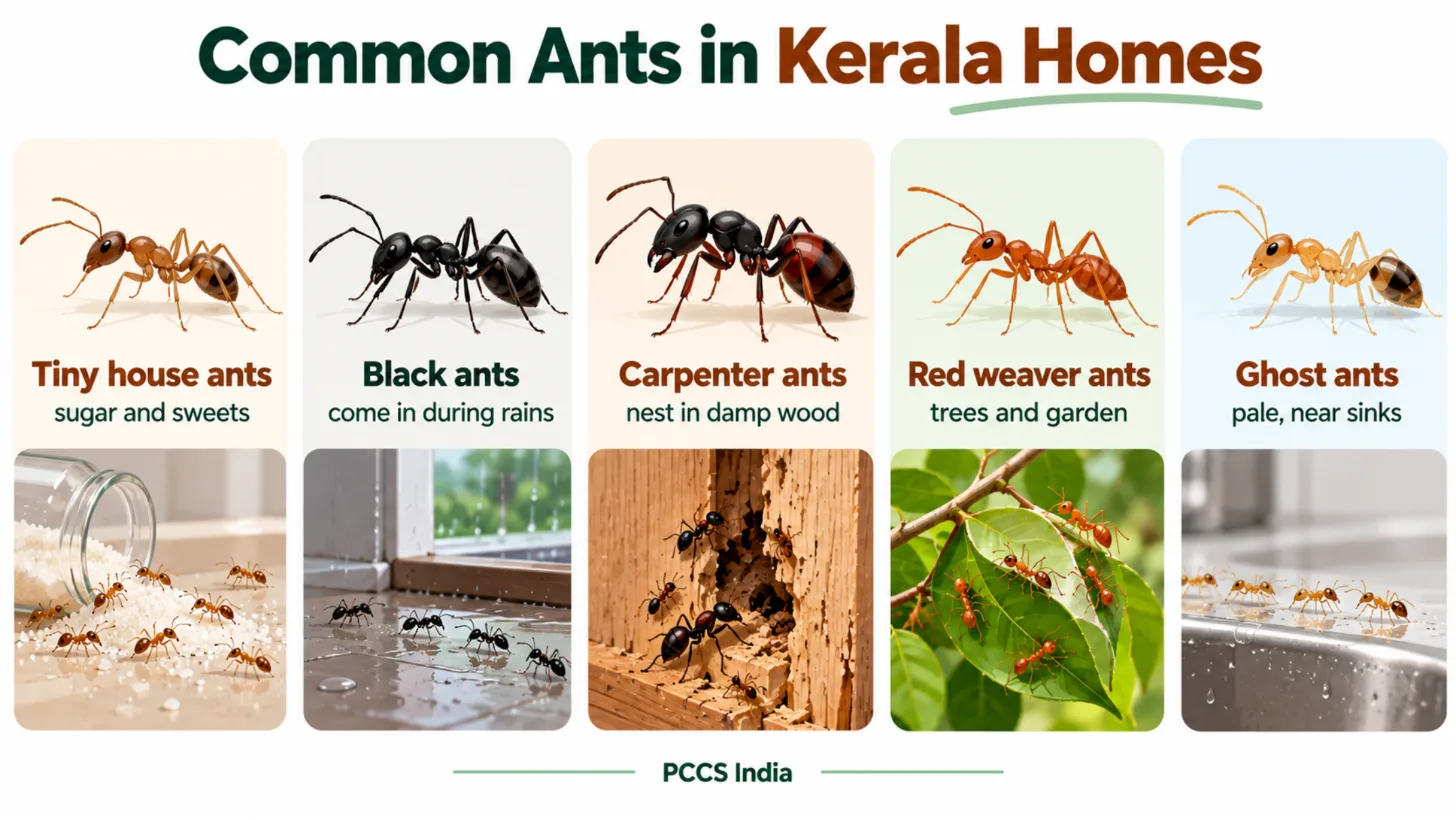
The tiny red or brown ones in the kitchen, going after sugar and sweets and that spoon of jam somebody left out. Pharaoh ants and similar small house ants. These are the ones that split colonies when you spray.
Black ants that come in big numbers during the rains, mostly from outside, through window frames and door gaps.
Carpenter-type ants, the big black fellows, who like rotting damp wood – the bottom of an old door frame, a window frame that’s been getting wet for years, the wooden ceiling in grandma’s house. Termites eat wood. These guys don’t eat it exactly, they just dig rooms inside it and move in.
The red weaver ants (neeru) that everybody in Kerala knows from the mango tree. Painful bite. They’re more of a garden and compound problem, but when the branches touch the house they come in too.
Ghost ants – you’ll barely see them, pale and nearly transparent, roaming near the bathroom sink.
Different ant, different home address, different fix.
So what actually gets rid of ants?
Finding where they live, and getting the poison back to the nest. That’s the whole idea in one line.
Here’s roughly how we go about it. Step one, we literally follow the ants. My new technicians laugh the first time, then they realise it’s the best twenty minutes we spend in the house. Start of the line, end of the line. Behind the switchboard? Under the granite slab? Out the window and down the wall? Wherever it vanishes, the nest is usually not far.
Then, for the small kitchen ants, we use slow-acting bait gel. Not spray. The foragers eat it, carry it back, and share it with the others, queen included. It takes a few days. You’ll actually see more ants on the bait at first, which scares people – “it’s getting worse!” – but that’s exactly what we want. Within a week or so the trails usually thin out and stop.
For nests in soil, in the compound or along the foundation, we do a targeted treatment outside, so they’re stopped before they get in. For ants nesting in damp woodwork, the wet wood itself is the real issue, and we’ll point that out to you.
And then the boring part. Sealing gaps. Fixing the leaking tap under the sink. Not leaving the dog’s plate full all night.
Things you’re doing that are probably making it worse
No judgement here, everybody does some of these.
Spraying the trail with a household insecticide. Already explained that one. Wiping the trail with only water – the ants follow a chemical scent line, and plain water doesn’t really remove it, so put a splash of vinegar or a drop of dish soap in. The sugar dabba with the lid that never closes properly, the jaggery on the plate, the banana bunch on the dining table. Plates rinsed and left in the sink till morning. Leaving pet food out. Letting the garden plants and tree branches touch the outer walls, which is basically a bridge.
Oh, and putting chalk lines everywhere. It might slow them a bit, that’s all. The nest is still there.
Can I do something on my own before calling anyone?
Sure, if it’s only a few ants, go ahead and try first. Shift every sweet thing into a proper airtight jar – the steel dabbas with the tight lids, not the ones that rattle. At night, give the counter a wipe with soapy water or vinegar water. That dripping tap under the sink? Get it fixed, ants are thirsty creatures too. Cut back the hibiscus that’s leaning on the kitchen wall. Seal the obvious cracks around windows and the kitchen pipes with a bit of white cement or sealant.
If it’s still going on after two or three weeks, or if you’re seeing ants in more than one room, or big black ones coming out of woodwork, that’s the time to get someone in. By then the colony is well settled.
Is it safe for children and pets?
That’s one reason we like gel bait. It’s put in tiny dots, in cracks and corners and behind appliances – places a child’s hand or a dog’s nose won’t easily reach – and it’s used in very small amounts compared to spraying the whole floor. Outside treatments are done in the soil and kept away from where kids play. We’ll tell you which areas to keep the kids off and for how long. Please don’t wipe the bait off thinking it’s dirt, that happens quite a lot actually.
Why ant control in Kerala is a bit special
Our weather. Long monsoon, humid the rest of the year, lots of greenery around the houses, trees right next to the wall. Perfect ant country. During heavy rain the outdoor colonies get flooded and move indoors, which is why so many people say “they came suddenly in June”. Older houses with wooden frames and tile roofs give carpenter ants plenty of damp wood. Flats aren’t safe either – one colony can travel through the wall cavities and pipe shafts across many floors, so it’s very common for the whole block to have the same ant.
So a one-time spray isn’t the answer here. A proper treatment, and maybe a quick follow-up, is.
How PCCS India handles ant problems
We’ve been doing pest control in Kerala for more than 15 years, homes, flats, hotels, offices, food units. Our technicians are trained to identify the ant first and only then decide what to use. We inspect, we bait or treat, and we tell you clearly what you need to change in the house so they don’t come back. If the problem continues after the treatment period, call us.
We work across Thiruvananthapuram and the other districts through our branches – Kollam, Kochi, Alappuzha, Kottayam and more.
Common questions about ant control
How long does ant treatment take to work?
With bait, you’ll usually see a big drop in a week or so, sometimes a little longer for a large colony. You may see more ants for the first couple of days. That’s the bait doing its job.
Will the ants come back after treatment?
Kill the nest, cut off what they eat and drink, and you’ll have peace for a good while. But this is Kerala – a fresh colony can always walk in from the garden, mostly when the rains start, and that’s why plenty of our customers just book us once a year and forget about it.
Will you spray the entire house?
No. For most indoor ants we don’t spray at all. It’s targeted bait and treatment in specific spots.
Are red weaver ants on the tree a problem?
Only if they’re getting into the house or biting people in the compound often. Usually trimming the branches away from the building solves most of it. We can treat the compound if needed.
Fed up with the ant line?
Call PCCS India on 0471-2353735 or 81138 50599, or message us through the contact page. Tell us where you’re seeing them and for how long. We’ll come take a look.