
I know why you do it. There is a cockroach on the counter, there is a tin of spray under the sink, and it dies. That feels like winning.
Here is what actually happened. You killed one out of maybe two hundred, and you taught the rest to avoid that part of the kitchen.
Why the tin makes it worse
Three reasons, and we see all three every week.
Most household aerosols are pyrethroid-based, and cockroaches can detect them and will avoid a treated area. So you spray the cupboard, and the survivors do not die, they shift. Into the wall void. Into the motor housing behind the fridge. Into the gap behind the tiles, where you will never reach them and neither will we. You have made them harder to get at and stopped them visiting the one place you could have baited.
Which brings the second problem, and this one causes more failed professional treatments in Kerala than anything else. Spray residue ruins bait. Spray a surface, then put gel near it, and the cockroaches will not touch the gel. When a treatment underperforms, the first thing I ask is whether anybody has been spraying in between. About half the time the answer is yes, and the person is usually a little embarrassed, and honestly they should not be. Nobody told them.
Third, spray does nothing to the egg cases. A German cockroach ootheca holds thirty to forty eggs, and the female carries it tucked into a crack until just before it hatches. No surface spray reaches that. You kill the adults, feel satisfied for two weeks, and the population comes straight back.
So: stop spraying, and tell your technician if you have been spraying. It changes what we are able to do.
Which one do you have?
Small, 12 to 16 mm, light brown, two dark stripes behind the head, living inside your kitchen cupboards and behind the fridge — German cockroach. Real indoor infestation. Gel baiting is the answer.
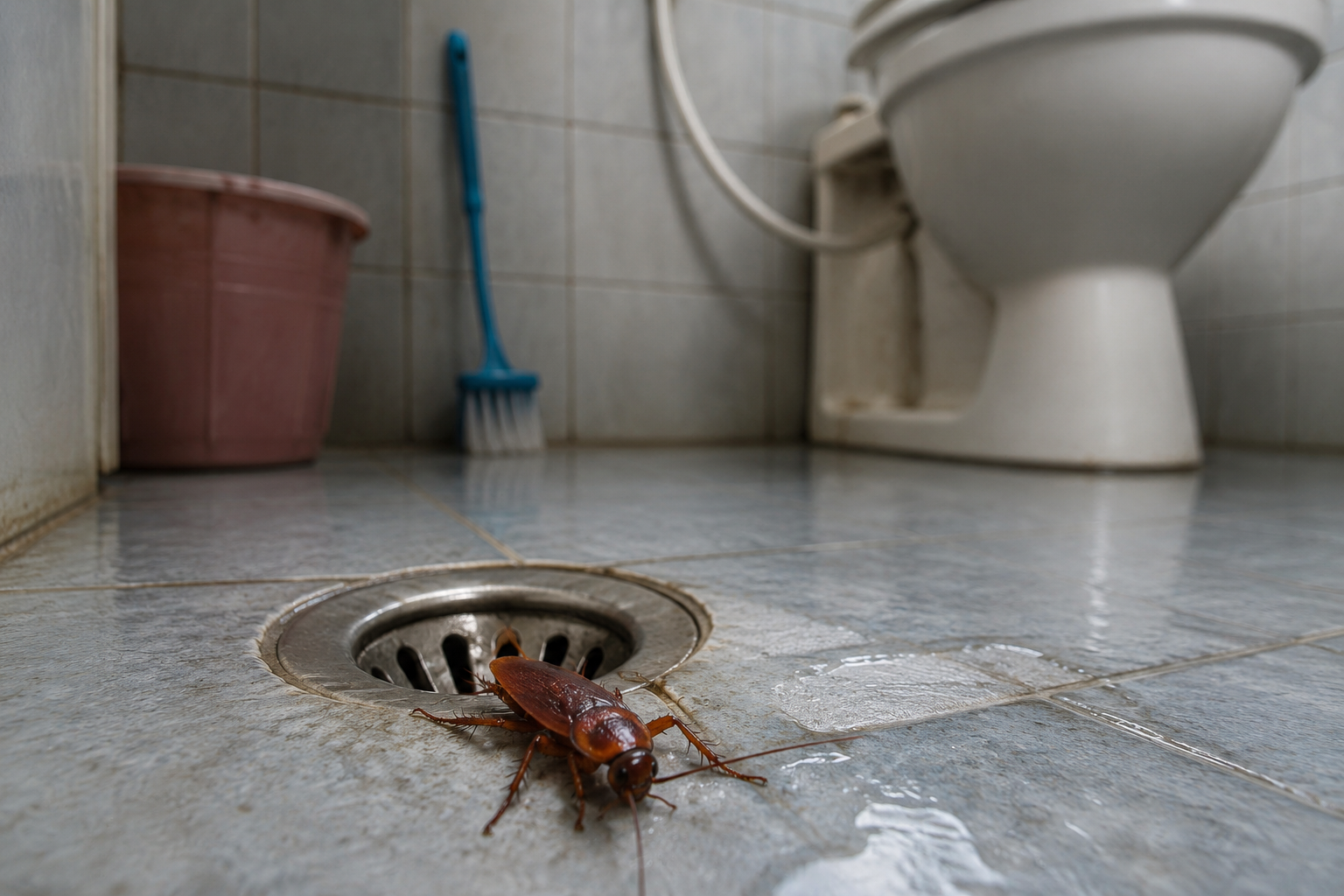
Big, 35 to 40 mm, reddish-brown, appearing on the bathroom floor at night and gone by morning — American cockroach, coming up from the drain. Treating your kitchen will not help at all. That is a drainage problem and there is a separate article on it.
Flats and newer construction here mostly get the German ones. Older houses on septic tanks get the American ones. Quite a few places have both and only ever get treated for one.
How gel actually works
Gel bait is a small dot of food matrix with a slow-acting insecticide in it. The slowness is the design, not a defect.
The cockroach eats, goes back to the harbourage, and dies there. Others feed on the droppings and on the carcass — cockroaches are cannibalistic and they eat each other’s droppings, which is unpleasant to think about and extremely useful to us — and pick up the active ingredient second-hand. That is the secondary kill, and it is how a treatment reaches insects that never went near a bait dot. The nymphs, which mostly stay in the harbourage and do not forage far, are killed almost entirely this way.
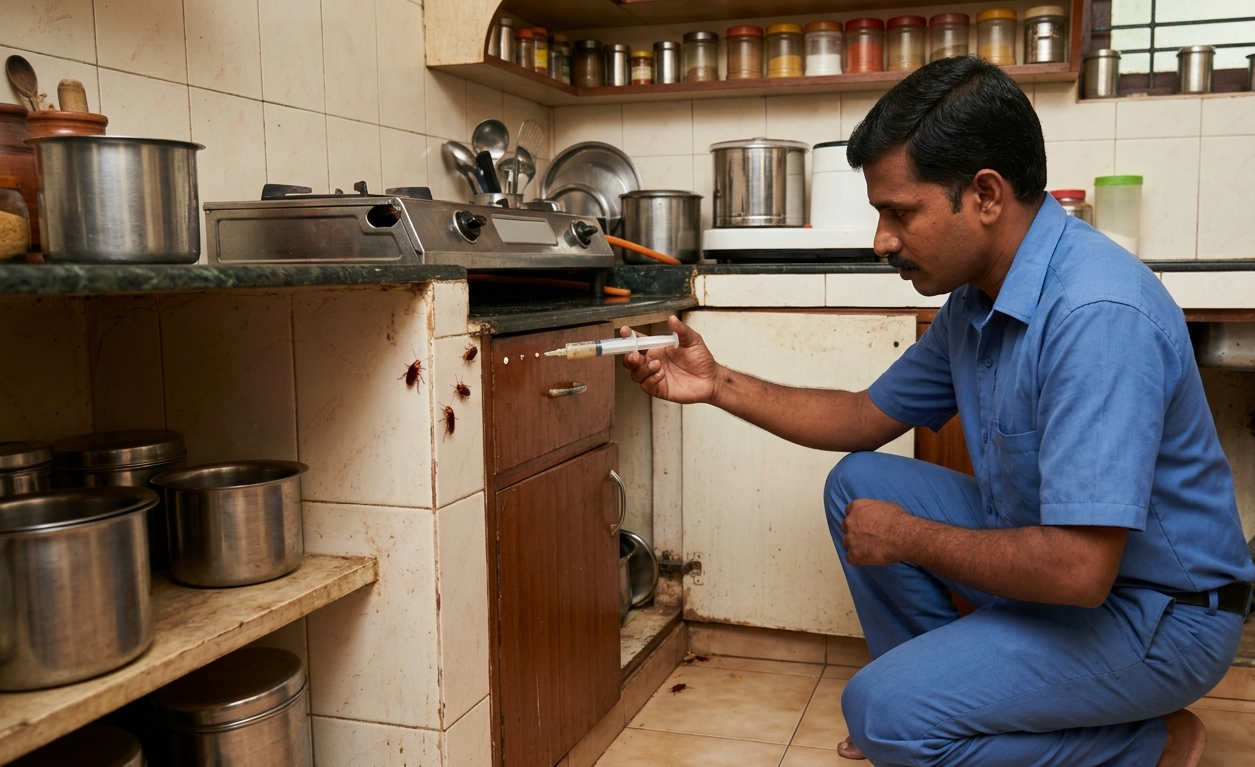
Placement is what separates a real treatment from a fifteen-minute visit. Gel goes into cracks, hinge recesses, cavity edges, undersides. The hinge recess of the cupboard door. Under the shelf lip. The gap behind the sink. The motor area behind the fridge. Under the gas stove. Drawer runners. Behind the switch plate. Never on an open surface, never where a child or a dog can reach, never anywhere it will be wiped off during normal cleaning.
A proper residential job is forty to a hundred and twenty placements. If somebody did your kitchen in fifteen minutes with a dozen dots, you did not get a treatment, you got a visit.
What happens when we come
Inspection first — which species, where the harbourage is, how heavy it is. That means looking behind and under the appliances, not glancing at the floor.
Then the sanitation conversation, which is always slightly awkward and always necessary. If there is a permanent food source in that kitchen, the treatment underperforms and there is nothing I can do about that from my side.
Then gel placement into cracks and voids at label rate. For heavy infestations we add a growth regulator, which stops nymphs reaching breeding age and closes the reproductive loop. If American cockroaches are involved, the drains and traps get treated as well.
Then a follow-up, where bait is checked and topped up and anything new gets treated. Every treatment carries a written warranty, and if activity continues within that period we come back free.
Expect to keep seeing cockroaches for one to two weeks. That is not failure, that is the treatment working — they are leaving the harbourage, feeding and dying out in the open where you can see them. A treatment that makes them vanish in two hours was a repellent treatment and they will be back next month.
Cost depends on kitchen size and how heavy the infestation is, so we quote after inspection. Hotels, bakeries and small restaurants are quoted separately.
While we are here: the ants
Ants and cockroaches run on the same fuel — food residue, moisture, cracks — and in most Kerala kitchens they are one hygiene problem showing up in two ways. Doing both in one visit costs less and works better.
Same rule, same reason: do not spray the trail.
When you wipe out a visible ant line you are killing the foragers, which is maybe five percent of the colony. The queen and the brood are untouched. Worse, with some species the disturbance triggers budding — the colony splits and sets up several new nests. You started with one ant problem and now you have four, and it genuinely happens that fast.
Ant gel works the way cockroach gel works. Foragers carry it home and share it mouth to mouth until it reaches the queen. Kill the queen and the colony collapses. Kill the foragers and you have achieved nothing except a clean-looking counter for one day.
The ones we see most here:
The tiny fast ones running a clean line to something sweet are ghost ants or sugar ants. They nest indoors in wall voids and in potted plants, and they are the ones most likely to bud on you if you spray.
Large black ones active at night, with fine sawdust underneath, are carpenter ants. They do not eat wood, they excavate it to nest. In an old house with hardwood rafters or a wooden ceiling that is a structural conversation, not a nuisance one.
Pharaoh ants matter mainly in hospitals and clinics because of contamination risk, and they must never be sprayed. They bud aggressively and you will end up with them in every ward.
Our ant work uses species-appropriate bait, treats the nest instead of the trail, and includes a moisture and entry-point check. Ants come in mainly for water in the dry months and mainly for shelter once the monsoon starts, and the fix is not the same.
The part we cannot do for you
Treatment fails in kitchens where the food stays available. So:
Wipe the stove and counter every night, including the gap between the counter and the wall, where everything ends up. Do not leave vessels soaking overnight. Rice, sugar and pulses into airtight containers, not the packet with a clip. Waste bin emptied nightly, lid on. If your waste collection is only twice a week, keep the wet waste sealed and outside, not under the sink.
Fix the dripping tap. Cockroaches survive weeks without food but only days without water, so water is the tighter constraint and it is the one you control.
And do not spray where the gel is. I have said it three times now, which should tell you something about how often it happens.
📞 Tel: 0471-2353735 | Mobile: 81138 50599 — free inspection, and a written warranty with every treatment.
Questions people ask
Why am I still seeing them after treatment? For the first one to two weeks that is expected and it means it is working. If activity is still increasing at three weeks, call us and we will come back under warranty.
Is gel safe with children and pets? It goes into cracks, hinges and voids they cannot reach, and the quantity per dot is very small. Tell us about crawling babies, pets and aquariums so we can adjust placement. Keep the treatment report, it lists what was used.
Can I clean the kitchen after? Clean normally. Just do not scrub inside the hinge recesses and drawer runners the technician points out. He should walk you around the placements before leaving. If he does not offer, ask.
How long does it last? Six months to a year in most houses here, with a follow-up and reasonable hygiene. Flats sharing walls and plumbing with untreated neighbours reinfest much faster. In an apartment block, getting several flats done together works far better than doing yours alone, and most associations find it cheaper per flat.
Is one cockroach an infestation? One big one in the bathroom is usually a drain issue. One small striped one in the kitchen almost always means many more, because they are cryptic and you only ever see a fraction. Take that one seriously.
PCCS India — cockroach and ant control for homes, flats, hotels and food units across Kerala.