
Here’s a thing that happens more than shop owners like to admit. Somebody opens the rice sack at 8 in the morning and there’s a little hole chewed in the corner. Or a customer at the billing counter points at the shelf and says, loud enough for everybody, “chetta, a cockroach.” Or the godown supervisor calls the owner at 7 am, half panicking, because the cartons along the back wall have been torn up into what is very clearly a rat’s bedroom.
At home, a rat is a nuisance, you chase it, you complain, you move on. In a supermarket, a godown, a hotel or a textile shop, it’s money, stock, reputation, sometimes a licence. So commercial pest control has to work differently, and that’s what I want to talk about here.
What is commercial pest control?
Simply put, pest control that’s built around a business. Shops, supermarkets, godowns, hotels, restaurants, offices, hospitals, schools, factories, malls, even bank branches. Not the “call when you see a cockroach, we come and spray” model. It’s a fixed programme – we come on fixed dates, keep pests out, catch trouble early, and write down every time what we found and what we did.
The culprits are mostly the same gang you see at home. Rats, cockroaches, ants, flies, termites, lizards, the little bugs that get into rice and atta, sometimes pigeons. The difference is the size of the place, how much is at stake, and the fact that we have to work around your shutter timings, not ours.
Why not just use household pest control for a shop?
Because a business has stock, customers and staff, all at the same time.
A supermarket has hundreds of food products sitting on shelves and in the store room – one rat colony behind the rice section and you’re throwing away bags of stuff every week. In a godown, lorries come and go all day from all over, and half the time the cockroaches are travelling free inside the cartons. Textile shops and furniture showrooms lie awake thinking about termites and moths. Hotels have kitchens downstairs and guests sleeping upstairs, two very different headaches under one roof. Hospitals have patients. And in all of these, nobody wants a strong chemical smell spread around while customers are inside.
Plus, many businesses get inspected or audited. Food businesses have FSSAI hygiene requirements, hotels get guest reviews, export units have buyer audits. “We sprayed last Diwali” is not going to satisfy anyone.
Which pests are the biggest headache for Kerala businesses?
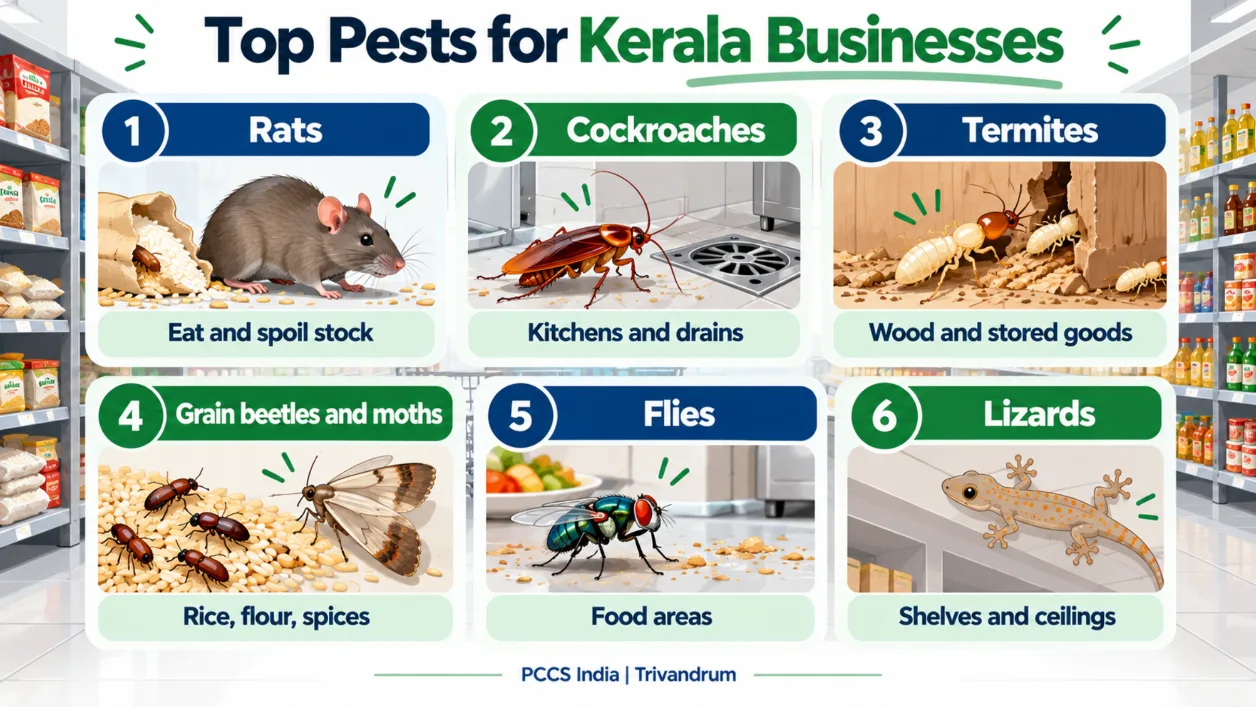
From what we see across Thiruvananthapuram and the other districts, these are the regular troublemakers.
Rats and bandicoots. Supermarkets, godowns, grain and provision stores, hotel stores, anywhere near a market or drain. They eat stock, contaminate it, chew wiring (which is a real fire risk), and breed quickly. And when the monsoon floods the open drains, guess where they all run to? Inside.
Cockroaches. Any place with food or water – the bakery, the hotel kitchen, the college canteen, the hospital pantry, even the staff toilet on the third floor of an office. They ride in on vegetable sacks and cartons and then settle down in drains, inside the warm motor of the fridge, and in that gap behind the oven nobody ever cleans.
Termites. Saree shops, furniture showrooms, bookshops, offices with those wooden partitions, any godown stacked on wooden pallets. They make no noise at all. You find out when a customer unfolds a silk saree and there’s a hole in it.
Rice and flour bugs. The tiny brown beetles and little moths that turn up in rice, atta, dal, spices, cashew and dates. If you run a supermarket or a provision store you’ve definitely had a customer bring a packet back.
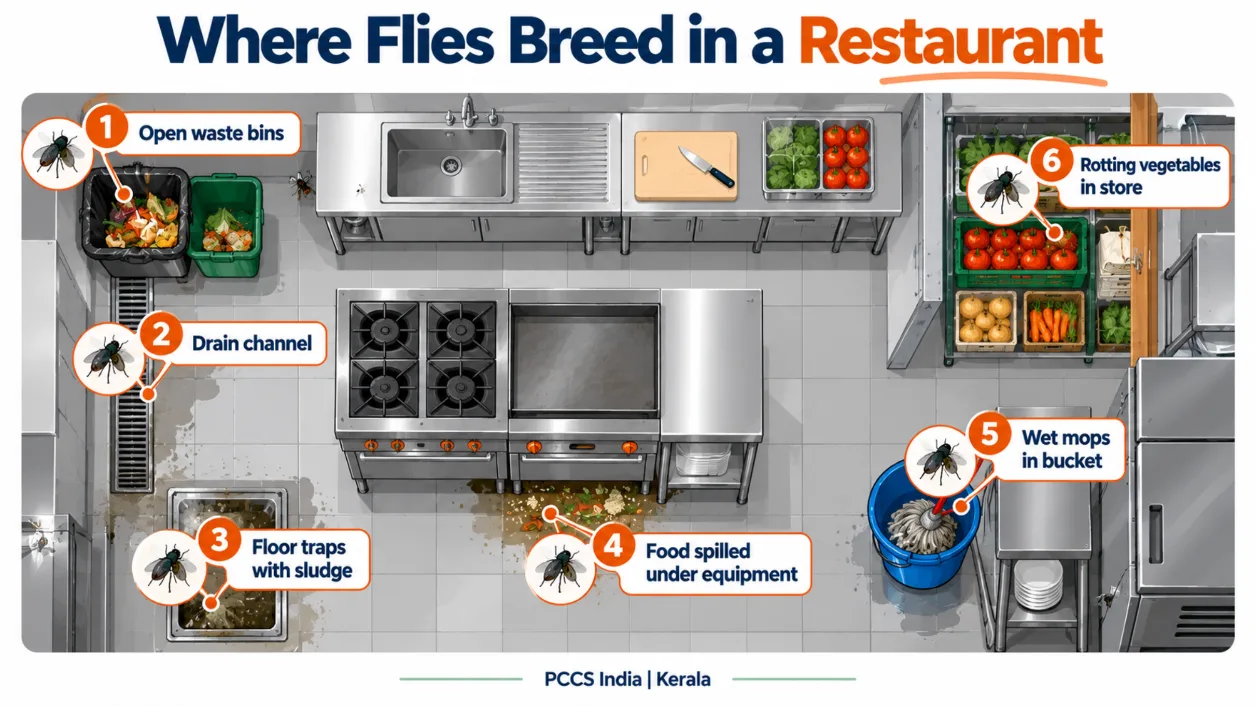
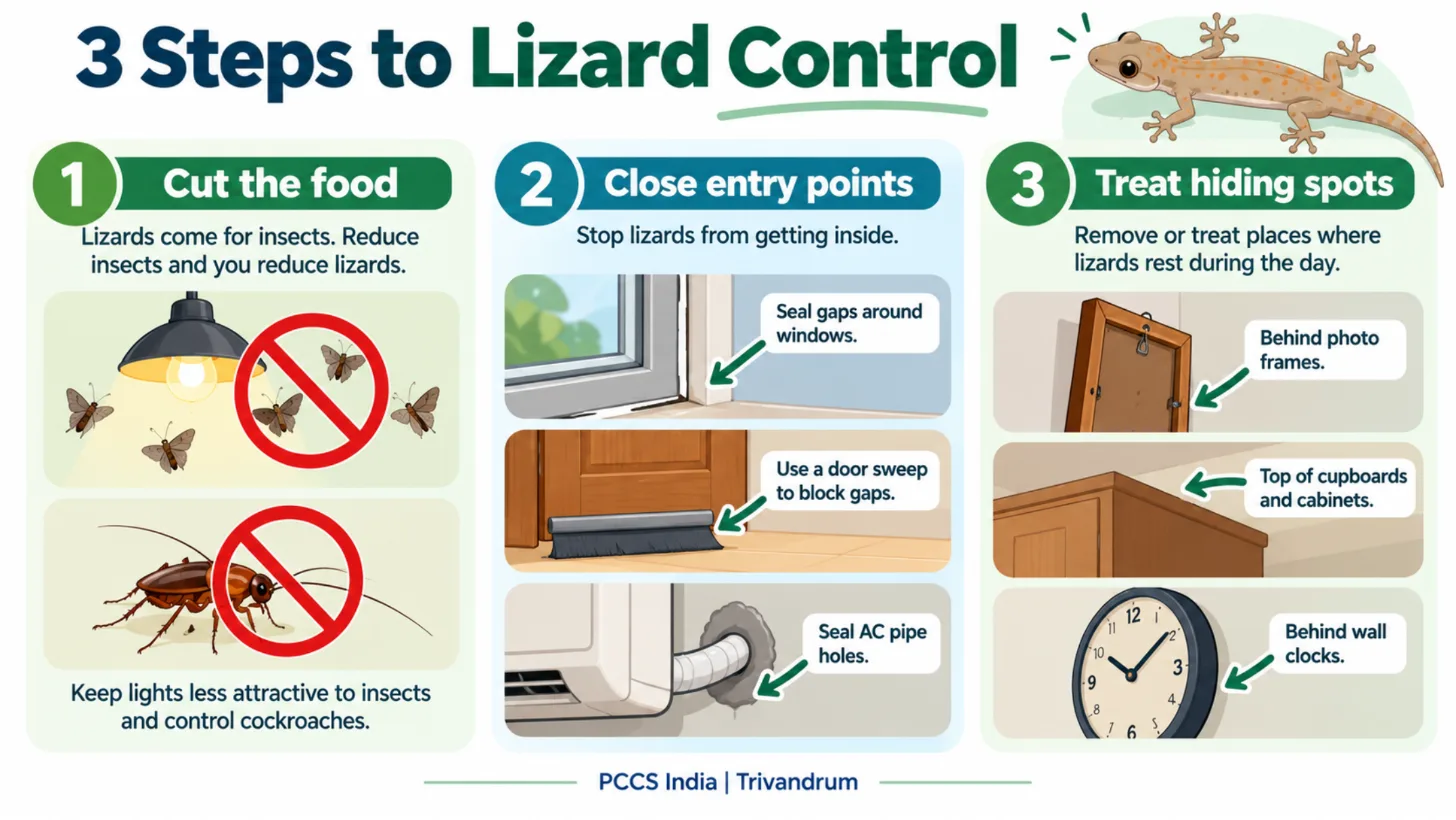
Flies and lizards. Food places especially. We wrote separately about fly control for restaurants.
What should a commercial pest control plan have?
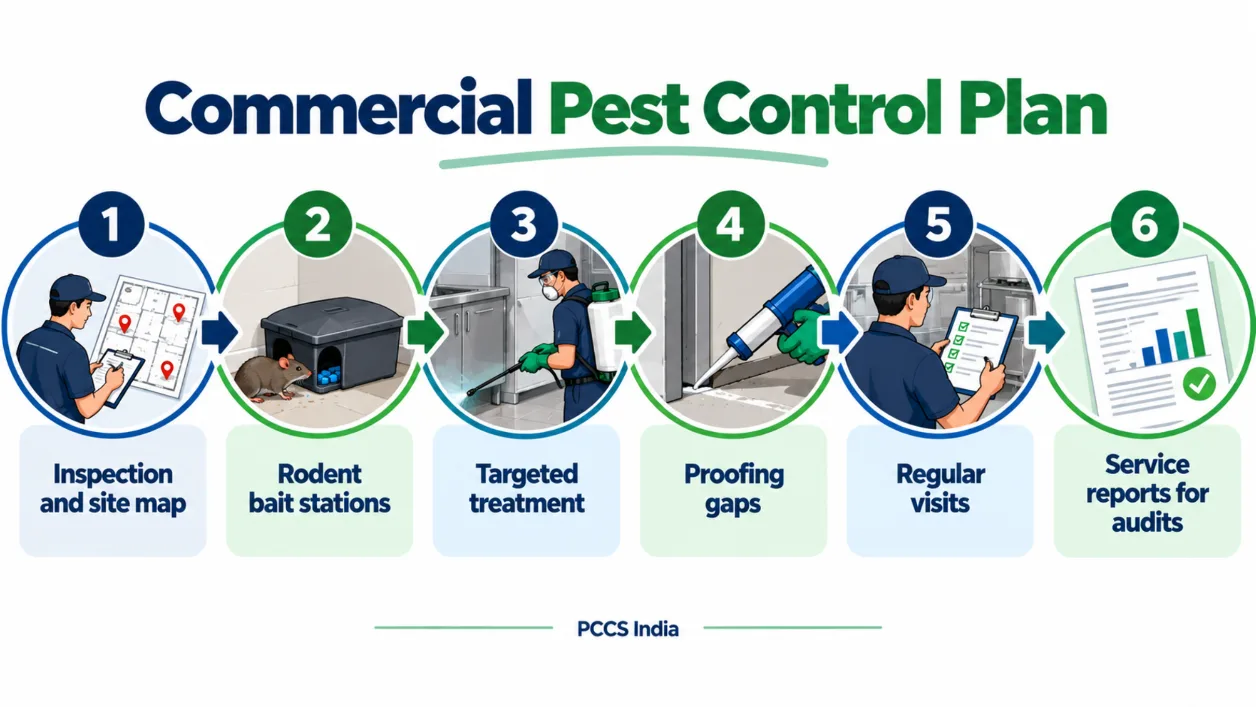
I never quote without walking the place first, because no two sites are alike. That said, a decent plan normally has these pieces in it.
Inspection and site map. We walk the whole place – store room, shop floor, kitchen, loading area, drains, outside walls, the false ceiling if we can get in – and note where pests are, where they could come in from, and where the risk areas are.
Rat boxes, and actually checking them. Locked bait boxes and traps, outside the building and inside, at the spots rats really use. Each one gets a number. Every visit, each one gets opened and checked, and we note down how much bait was eaten or what got caught. That simple count tells us honestly whether we’re winning or not.
Targeted treatment. Gel baits for cockroaches in cracks and equipment gaps, treatment for ants and other insects where needed, termite treatment where there’s activity. Not a blanket spray over everything, and never on food or food contact surfaces.
Proofing advice. The gaps under shutters, holes where pipes go through walls, broken mesh, the drain without a cover. We point these out, because the cheapest pest is the one that never gets in.
Regular visits. Monthly for most businesses, more often for food handling, supermarkets and hospitals, less for some offices.
Reports. A service report after each visit with what was found and done. Keep these on file. They’re useful for audits and inspections.
Can it be done without closing the business?
Yes, in almost every case. We plan visits before opening, after closing, on weekly holidays, or in sections, so your customers never see us. Treatments that need people out of the area are done when the area is empty. For 24-hour places like hospitals and hotels, we work room by room or zone by zone.
Some honest advice for shop and warehouse owners
A few things that make a huge difference, from what I’ve seen over the years.
Check what’s coming off the lorry. Cockroaches and even rats come in with vegetable sacks, carton boxes, those cheap second-hand pallets – have someone glance at it before it goes in. Stock on racks or pallets, never straight on the floor, and leave a small gap from the wall so a broom (and my technician’s torch) can get behind. First in, first out. Old stock sitting in a corner for months is where beetles start. Keep the waste area clean and closed, and get waste out daily. Don’t let staff eat in the store room. And when the pest control person tells you about a gap under the shutter, please get it fixed. I can treat it every month, but if the door is open to them every night, you’re paying for the same rats again and again.
Why businesses choose PCCS India
Fifteen-plus years now we’ve been handling pest control for Kerala businesses (and homes too). Supermarkets, hotels, hospitals, schools, IT offices, godowns, factories, we’ve done the lot. The boys are trained before they go out. We come when it suits your shop, not when it suits us, and you get a report every single visit. Need commercial cleaning or sanitization along with it? Same team, one bill. Sundays and holidays also fine.
Trivandrum is home base, and our branches cover Kollam, Kochi, Ernakulam, Alappuzha, Kottayam and a few more. See our pest control services page for the full list.
Questions business owners ask us
How often does a business need pest control?
For most shops, hotels and supermarkets, once a month is what we usually do. A hospital, a food processing unit or a really busy kitchen, more than that. A quiet office, maybe less. We’ll know after the inspection.
Is it safe to do pest control in a food area?
Done properly, yes. We pick products meant for food businesses, nothing goes on food or the surfaces it touches, and we come in when the kitchen or store is empty.
Will we get reports for FSSAI or audits?
Every visit, yes. Keep them in a file, the inspector or the buyer’s auditor will want to see them.
How is the cost decided?
Size of the place, what kind of business, which pests, how many visits. First we see it, then we tell you the price.
Can you treat termites in a shop or godown?
Yes, we check the whole place, the wooden fittings, racks, pallets, and treat wherever they’re active.
Don’t wait for the customer to spot it first
Call PCCS India on 0471-2353735 or 81138 50599, or message us through the contact page. Tell us the type of business, location and size, and we’ll set up a site inspection.