
If you run a hotel, a bakery, a tea shop, a meat stall, a catering unit, any kind of food business in Kerala, you already know flies are part of the fight. You open at six, by nine they’re on the glass counter, by lunch there are five of them doing circles over the biriyani vessel and a customer is waving his hand over his plate and looking at you.
That look costs you more than any fly spray ever will.
I’ve walked into a lot of kitchens in Thiruvananthapuram and around, small and big, and the fly problem is nearly always solvable. But not with the cans of spray kept next to the cash counter. Let’s go through what actually works for fly control in restaurants and food units.
Why are flies such a big problem in food businesses?
Because flies don’t just sit on food. A house fly lands on garbage, on the drain, on the fish waste out back, and then on your parotta. It carries whatever was on its legs and mouth. They also vomit a bit on food to soften it and leave droppings – those little dark specks on lights and walls. Flies are known to spread bacteria that cause food poisoning and diarrhoea.
Then there’s the business side. One customer posts a photo of a fly in the curry and you’ll be explaining it for weeks. Food safety inspections look for pest control too. FSSAI hygiene rules expect food businesses to keep pests out and to have a proper pest control arrangement in place, so flies all over the prep area is not a small matter.
Where do restaurant flies actually come from?
Here’s the thing, they don’t come from far. Somewhere within shouting distance of your kitchen there is something wet and rotting, and that’s their maternity ward. The mother fly drops her eggs into the waste, maggots come out, and in our heat that whole thing from egg to a grown fly takes maybe a week, ten days at most. Which means – kill a hundred today, and next week a fresh hundred arrive from the same bin. You’re fighting a factory.
The usual suspects I find:
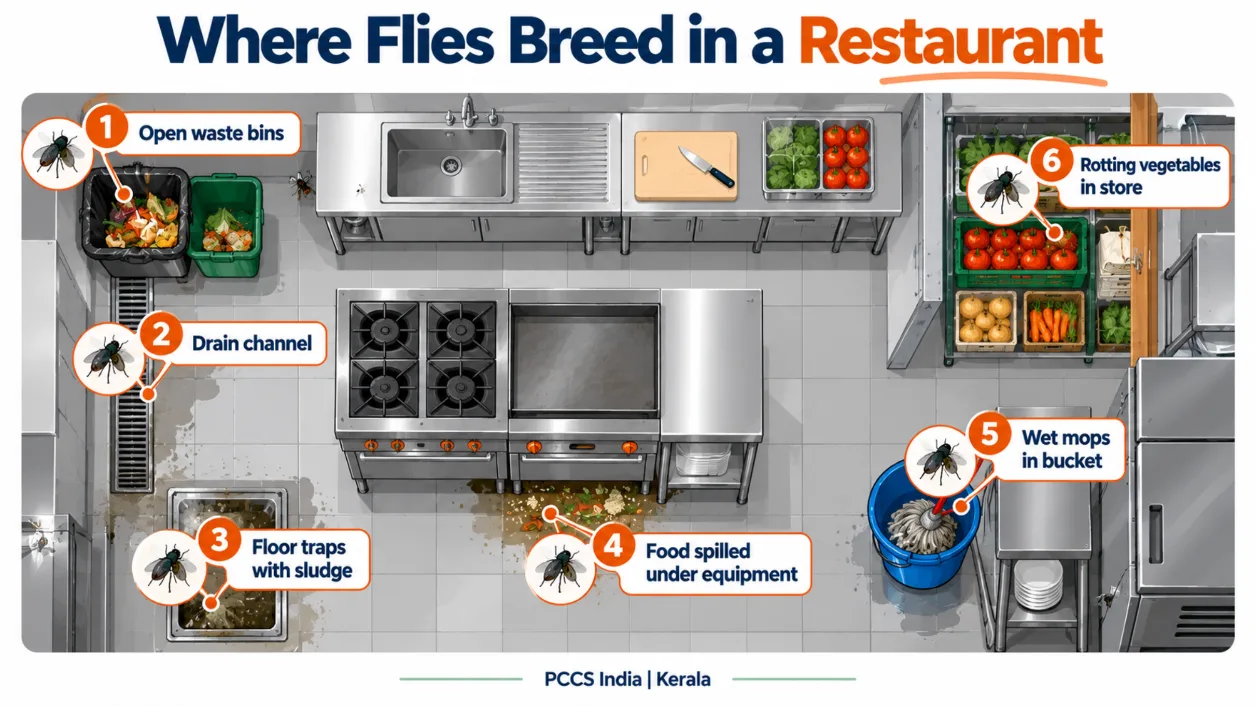
- Waste bins without lids, or bins that are emptied but never washed
- The drain channel behind the kitchen, and floor traps with food sludge in them
- Fish and chicken waste kept outside “until the collection comes”
- Spilled food under heavy equipment – under the fridge, under the tandoor, behind the grinder
- Wet mops left in a bucket overnight (small fruit flies love that)
- Rotting fruit and vegetables in the store
- A neighbouring shop or market with poor waste handling, which is the annoying one
House fly, fruit fly, drain fly – which one is yours?
Worth knowing, since each needs its own fix.
House flies – the fat grey ones everybody knows. Garbage outside is home for them, and your open door is the entrance.
Fruit flies – tiny, red-eyed, always hanging over the juice counter, the banana bunch, anything fermenting, and oddly enough, the wet mop.
Drain flies – you’d almost think they’re baby moths, fuzzy and grey, parked on the wall beside the drain. That black slime coating the inside of your floor trap? That’s their nursery.
When someone says “flies are coming” I always ask which ones. A juice shop and a fish restaurant have very different problems.
What actually controls flies in a restaurant?
It’s a combination, and honestly the cleaning part matters more than the chemical part.
Remove where they breed. Get bins whose lids actually shut, wash the bins themselves (not only empty them), and don’t park them right outside the kitchen door. Every day, the waste leaves the building. Every day. Floor traps and drains, someone has to get in there with a brush and scrub the slime off – pouring a bucket of water down does nothing. Clean under equipment. If there’s a breeding source we can’t control (the next-door shop, a dump nearby), we focus harder on keeping them out.
Keep them out. Mesh on the windows, mesh on the exhaust fan openings. Those plastic strip curtains, or an air curtain if your budget allows, on the back door and wherever the kitchen opens out. Self-closing doors where possible. Many places have all these, but the back door is kept wide open all day for deliveries, which cancels everything.
Catch the ones that get in. UV fly catchers with glue boards are much better than electric zappers for food areas. Zappers burst the fly and bits of it can spread around, which you don’t want near food. The glue board type traps them cleanly. Placement matters – they shouldn’t be directly above food prep or visible from the entrance, and they shouldn’t be competing with bright lights. We’ll suggest where.
Targeted treatment. Approved fly baits and residual treatments in places like the waste area, drains and outside walls, never on food surfaces or utensils. Done at the right time, usually after closing.
Can’t I just spray before opening?
I know many shops do this. Spray at closing time, spray again in the morning. Two problems. Spraying around food contact areas is risky, and the smell stays. And it does nothing about the eggs and maggots in your drain or bin, so the next batch comes out the same day. You’re basically paying every day for a problem that keeps coming back.
How often should a food business get pest control?
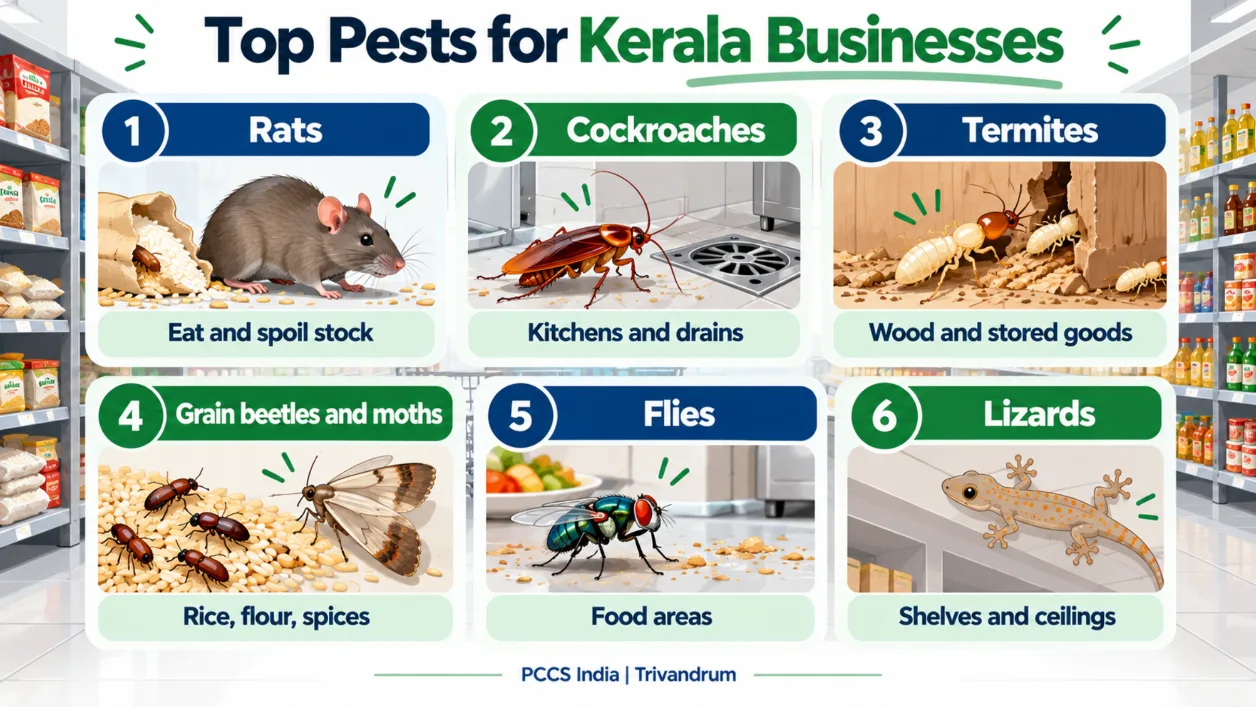
For most restaurants and food units, a regular service – commonly monthly, sometimes more often for busy kitchens or meat and fish places – works best. Flies are one part of it. Cockroaches and rats usually come with the same conditions, so a good plan covers all three. We give a service report after each visit, which is useful to keep on file for inspections and audits.
A simple daily checklist for your staff
Print this and put it near the kitchen door, honestly it helps.
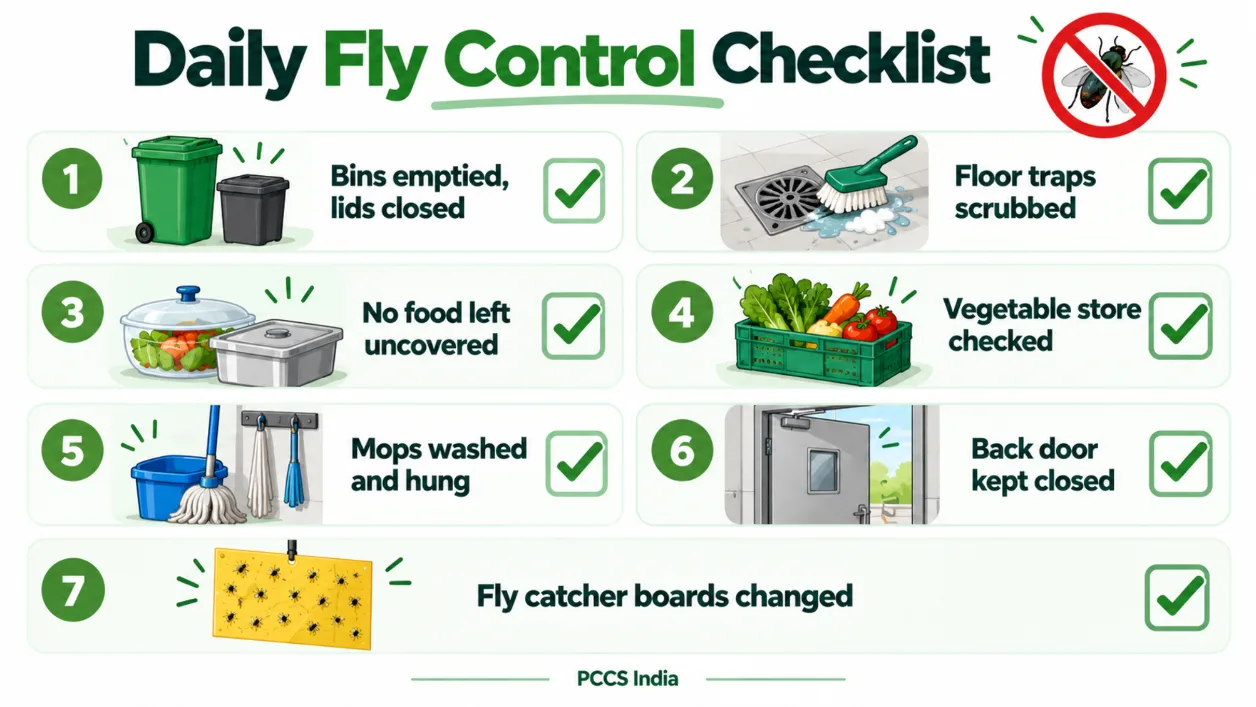
- Bins emptied and lids closed at closing time
- Floor traps and drain channel scrubbed, not just rinsed
- No food left uncovered, even for a few minutes
- Fruit and vegetable store checked for anything going bad
- Mops washed and hung to dry, not left in the bucket
- Back door closed when not in use
- Glue boards on fly catchers checked and changed when full
Why PCCS India for restaurant pest control
Fifteen-plus years now we’ve been in and out of Kerala’s hotel kitchens, bakeries, college canteens, fish processing units, you name it. My boys understand that a kitchen can’t just stop for us at 1 pm on a Sunday, so the visits get fixed around your rush, and whatever we use near food is meant for food areas. We don’t just treat and leave; we’ll point out the breeding spots and the entry gaps and tell your staff what to fix. You get a report each visit.
You can read about how we work with commercial clients on our pest control service page, or our earlier post on pest control solutions for restaurants in Trivandrum.
Questions restaurant owners ask
What is the best fly control method for a restaurant?
There’s no single best one. Removing breeding spots, screening doors and windows, glue-board UV fly catchers, and targeted treatment in waste and drain areas, together. Each one alone won’t be enough.
Are electric fly zappers okay in kitchens?
We don’t recommend them near food. Glue board fly catchers are cleaner because the fly is trapped whole.
Will pest control treatment affect our food?
Not if it’s done correctly. Treatments are kept away from food and utensils, done after hours where possible, and food is covered or stored before we start.
Do you provide reports for FSSAI or audits?
Yes, we give a service report after each visit that you can keep for your records.
Let’s sort out the flies
Call PCCS India on 0471-2353735 or 81138 50599, or use our contact page. Tell us what kind of food business you run and where you’re seeing the flies, and we’ll fix a visit at a time that doesn’t disturb your service.