
Almost every termite job I have attended was found late. Not because the owner was careless, but because there was nothing to see.
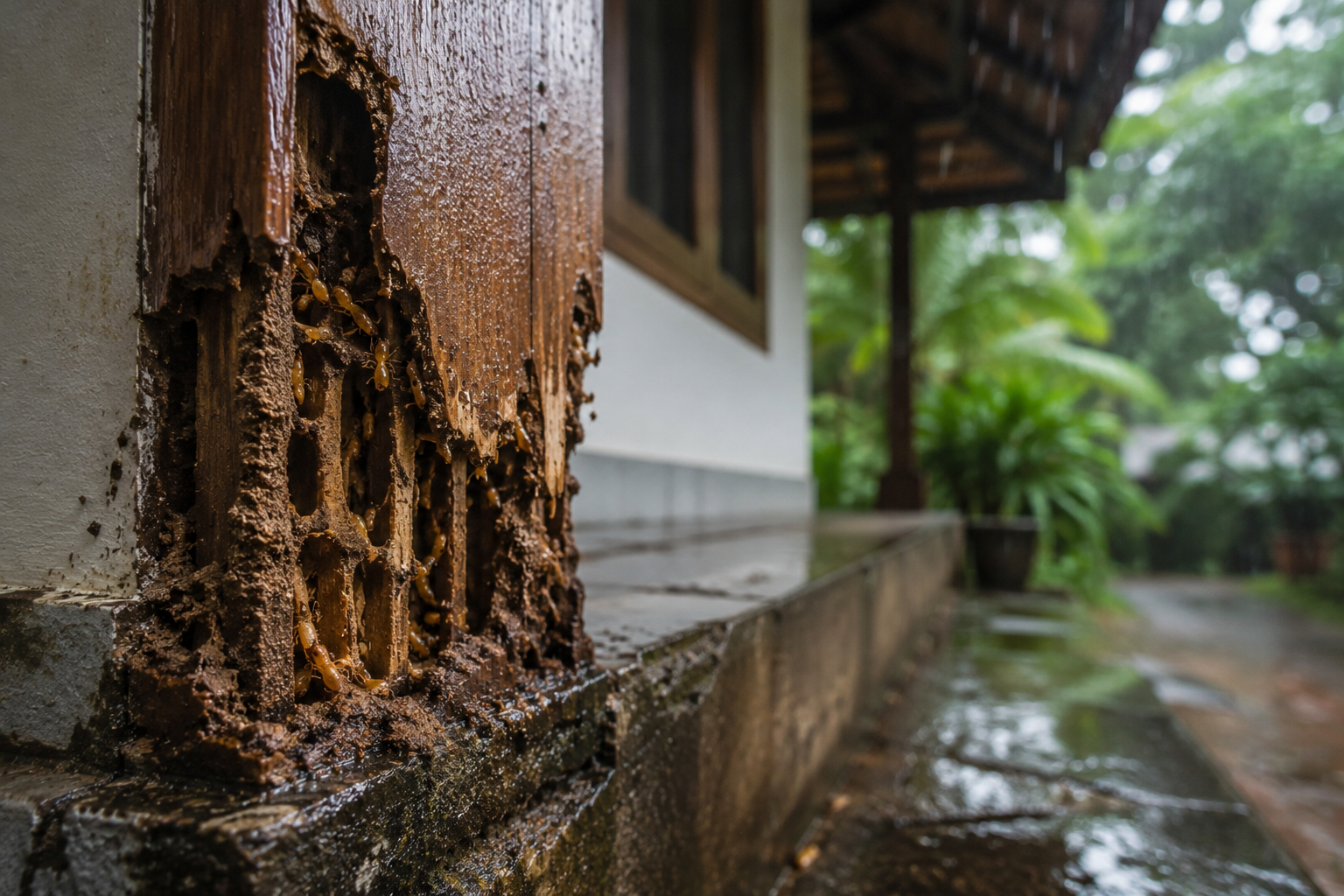
A colony can work inside a wooden beam for two or three years, hollowing it out and leaving the outer skin perfectly intact. One day somebody taps it, it sounds like cardboard, and that is the first anyone knew.
Kerala is a hard place for this. Subterranean termites want moisture, cellulose and warmth, and we supply all three without a break. Our soil rarely dries out enough to slow them down even outside the monsoon. Traditional construction here uses timber generously — roof structures, rafters, ceiling boards, door and window frames, staircases, panelling, and in an old family house the hardwood and teak that everybody is proud of — so there is far more accessible food in an average Kerala house than in a comparable house up north. Laterite is porous and full of fissures, which gives them protected routes upward that nobody can see. And there is no cold season here to interrupt a colony, so they never stop.
What I look at, in the order I look at it
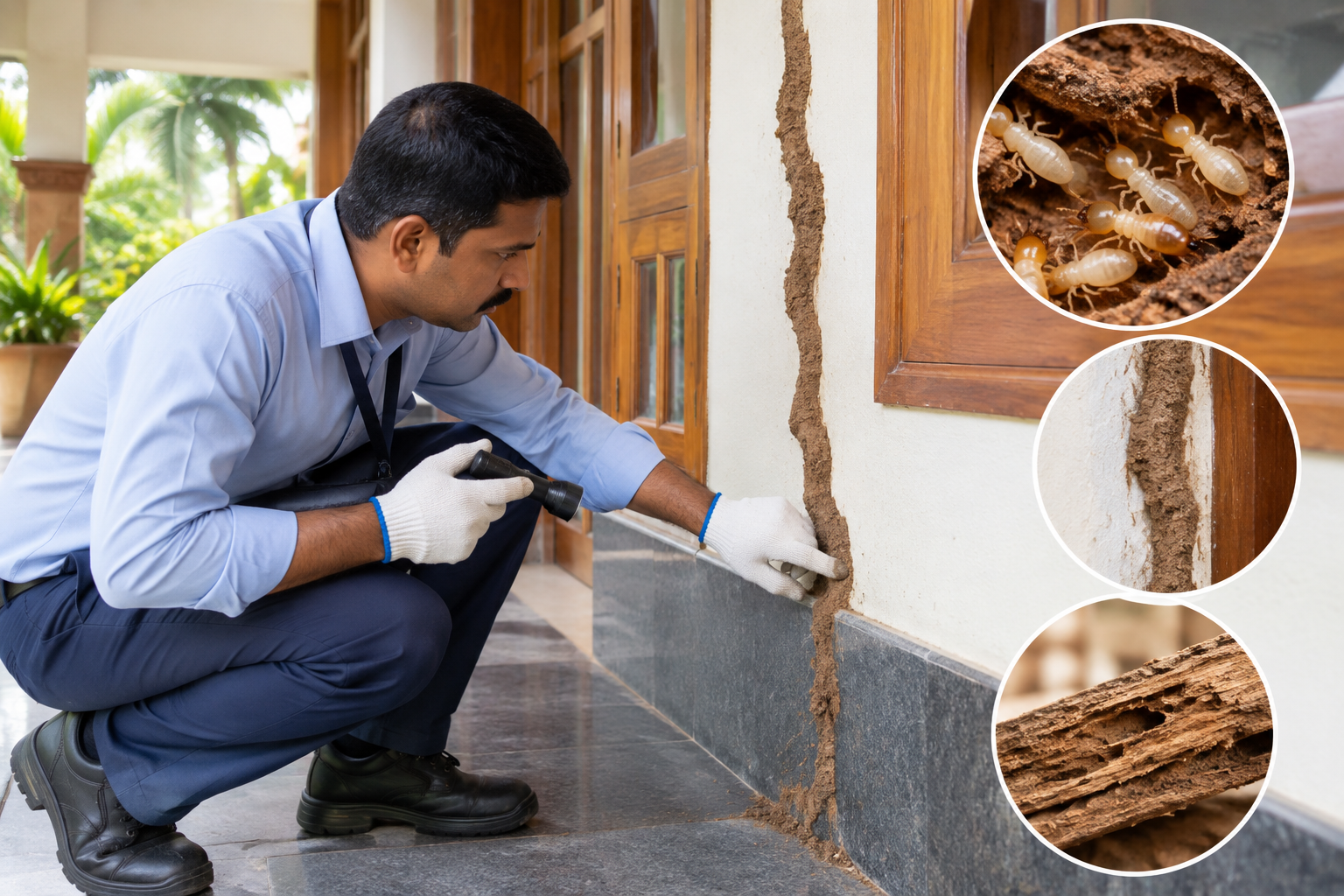
Mud tubes. Pencil-width earth tunnels running up a wall, a plinth, a pillar, the inside of the compound wall. That is the definitive sign, and if you find one, stop reading and call somebody. Mud tubes are not subtle once you know what you are looking for, but people walk past them for years assuming it is just dirt.
Hollow wood. Knuckle-tap the door frames and the skirting. If it sounds papery, the inside is gone and you are tapping a shell.
Swarming. Winged termites around the tube light after the first heavy rain. People sweep them up and forget about it, and that is a mistake. The swarm is not the problem, it is the symptom. It means a mature colony somewhere within range decided conditions were right to reproduce. And the swarm stopping does not mean they left. It means the alates dispersed to start new colonies, possibly in your own compound.
Discarded wings on the windowsill or near the light, after a swarm has landed.
Blistered or rippled paint on a wall or frame, which means moisture and activity behind the surface.
Doors and windows that have suddenly started sticking when nothing else changed.
Fine, gritty, soil-like frass underneath timber.
And in Kerala specifically, the store room. Books and old papers with tight tunnelled patterns eaten through them. It is so common here that I check it on every inspection without being asked, and I find something more often than not.
If you are building, do it now
Pre-construction treatment is the cheapest termite protection you will ever buy, by a wide margin. It goes in as the building goes up, treating the soil so that a chemical barrier sits between the ground and the structure.
Foundation pits and trenches before laying. The backfill earth as it goes back in. The top of the fill under the floor slab, before the plinth concrete. The wall-and-floor junction, which is where most breaches happen. A treated trench around the finished plinth. And the expansion joints, pipe entries and service ducts, which are the routes that defeat otherwise sound barriers.
Indian practice follows IS 6313 for this. Ask your contractor whether he is working to it and get the answer in writing.
Now the uncomfortable part. Pre-construction treatment is invisible the moment the building is up, which makes it the easiest line in a construction budget to quietly skip or thin down. I have seen certificates for treatment that plainly never happened, and the owner only discovers it six years later when the door frames start going.
So: be there when it is done. Photograph each stage on your phone. And insist on a written certificate stating the chemical used, its concentration, the quantity applied and the area covered. A certificate without those four things is not worth the paper.
If you are building from abroad and a relative is supervising, this is the one stage worth video-calling for.
If the building already exists
The barrier has to be created afterwards, and there are two honest ways to do it.
Drilling and injection. Holes at roughly 300 mm intervals along the internal wall-floor junction and the external plinth, termiticide pressure-injected into each one to saturate the soil underneath and form a continuous treated zone. Holes sealed and finished after. Done well you can barely find them; done badly you get a visible dotted line around every room for the life of the building. Ask to see photographs of previous work before committing. Infested and vulnerable timber gets treated separately, and there is a trench along the outer wall treated and backfilled.
Baiting. In-ground stations around the building holding a cellulose matrix with a slow-acting growth inhibitor. Foragers carry it back and it moves through the colony, eliminating it rather than repelling it. Slower — months, not immediate — but no drilling, far less chemical, and it suits heritage buildings, houses with small children, and expensive flooring. It needs ongoing monitoring, which means an ongoing relationship with whoever installs it.
Both are legitimate. Which is right depends on your building and your patience, and we will tell you which one we would pick for your house and why.
Why the cheap quote costs more
Post-construction cost depends on built-up area, number of floors and how far the activity has spread. Pre-construction is charged per square foot and works out to a fraction of the same job done later, which is the strongest argument for doing it while you are still building.
When a quote comes in far below everybody else’s, it is usually one of these, and I have seen all of them:
Diluting below label concentration. The commonest shortcut, completely invisible, and it fails in twelve to eighteen months, by which time the company may not be answering the phone.
Drilling at wider spacing than specified, leaving untreated gaps between injection points.
Skipping the external trench, because it is hard work and nobody is watching.
Treating only the room where you saw the termites, leaving the colony intact.
Or spraying visible wood and calling it termite treatment. That is not termite treatment. It kills what you can see while the colony carries on underground.
Before signing anything, ask for the chemical name and concentration, the drilling interval, whether external trenching is included, the warranty period, and precisely what the warranty covers. If the answers are vague, that is your answer.
What we do
Free inspection, including probing, moisture readings and a look at accessible roof timber and the store room. A written report with photographs and a marked plan of where the activity is. Pre-construction work applied in stages with a stage-wise certificate. Post-construction by drilling and injection, with wood treatment and external trenching. Baiting where drilling is not suitable. CIB&RC registered termiticides at label rate, applied by licensed applicators. A written warranty with annual inspection included.
And advice on the moisture and timber-contact problems that let them in, because if the drainage against your plinth stays broken, we will be back and so will they.
We have customers who have posted publicly about no recurrence at eighteen months and at two years. I would rather point you to those than make the claim myself.
📞 Tel: 0471-2353735 | Mobile: 81138 50599 — inspection is free anywhere in Thiruvananthapuram district.
Questions people ask
Termites or wood borer? Termites leave mud tubes and hollowed wood with soil packed into the galleries. Borers leave clean round exit holes and powdery frass, no mud. If soil is involved, it is termites. If you are not sure, photograph it and WhatsApp it to us. Identification decides the whole treatment.
Does pre-construction treatment last forever? No. Barrier chemicals degrade in soil, and buildings settle, crack and gain new pipe penetrations. Expect a useful life of several years and start inspecting from year five. Any certificate promising permanent protection should worry you.
Will you have to drill my new floor? Post-construction needs drilling along the wall-floor junction, at the grout line wherever possible. Sealed afterwards and, done properly, barely noticeable. If drilling is genuinely unacceptable — heritage property, imported stone — baiting avoids it entirely.
What does it cost here? Post-construction depends on built-up area and how far it has spread. Pre-construction is per square foot and much less. We quote after a free inspection.
Are the chemicals safe for the family? Registered termiticides at label rate, applied by trained people, with a stated re-entry interval. Most of it ends up in soil under the floor rather than in living space. Tell us beforehand about infants, pregnancy, asthma, pets or fish so we can adjust. It is a normal request and nobody minds it.
The swarm stopped. Am I fine? No. It means the alates dispersed, not that the colony left. Get it inspected.
PCCS India — anti-termite treatment, pre-construction and post-construction, across Thiruvananthapuram and all Kerala districts.