
Two or three times a week somebody calls us with the same story.
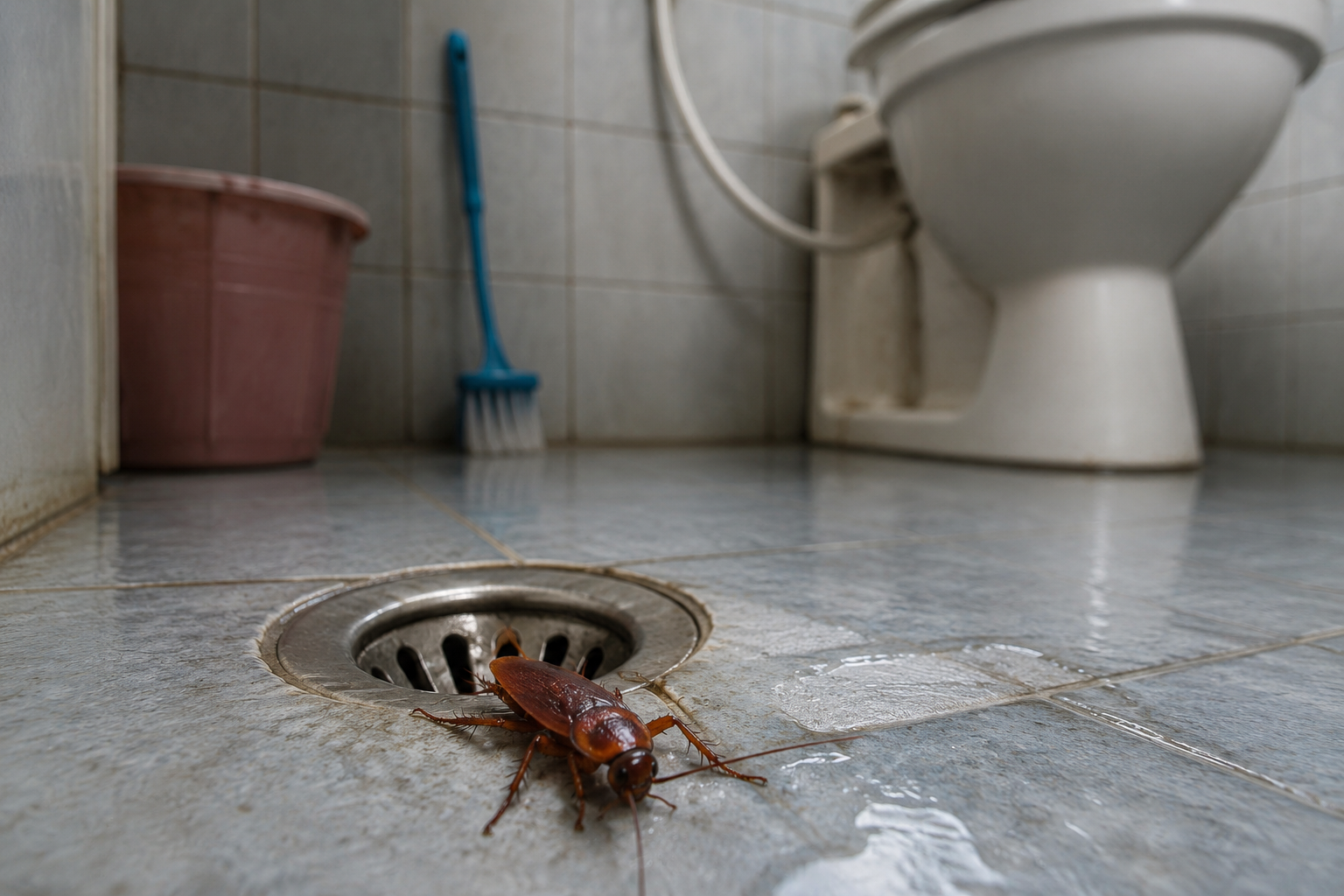
One o’clock in the night, they get up, switch on the bathroom light, and there are three or four big brown cockroaches sitting on the wet floor. By the time they come back with a slipper, the cockroaches are gone. Next morning nothing. No droppings, no egg case, no nest anywhere. Kitchen spotless. Waste bin covered. The lady of the house has been washing that bathroom every single day for fifteen years and she is, quite rightly, insulted by the whole thing.
So let me settle this. Those cockroaches are not living in your house.
They are living in your drain.
The big ones and the small ones are two different problems
Nobody tells people this, and it decides what treatment you should actually be paying for.
The large reddish-brown ones — 35, 40 mm, the ones that fly at your face when the fan is on — are cockroaches. They want warm, wet, and full of rotting matter. Which describes the inside of a sewer line in Thiruvananthapuram almost exactly. They live in the manhole, the inspection chamber, the septic tank, the soak pit, and the common line running under the road. At night they come up the pipe, spend a few hours in your bathroom, and go back down before light.
That is why you never find the nest. There is no nest to find.
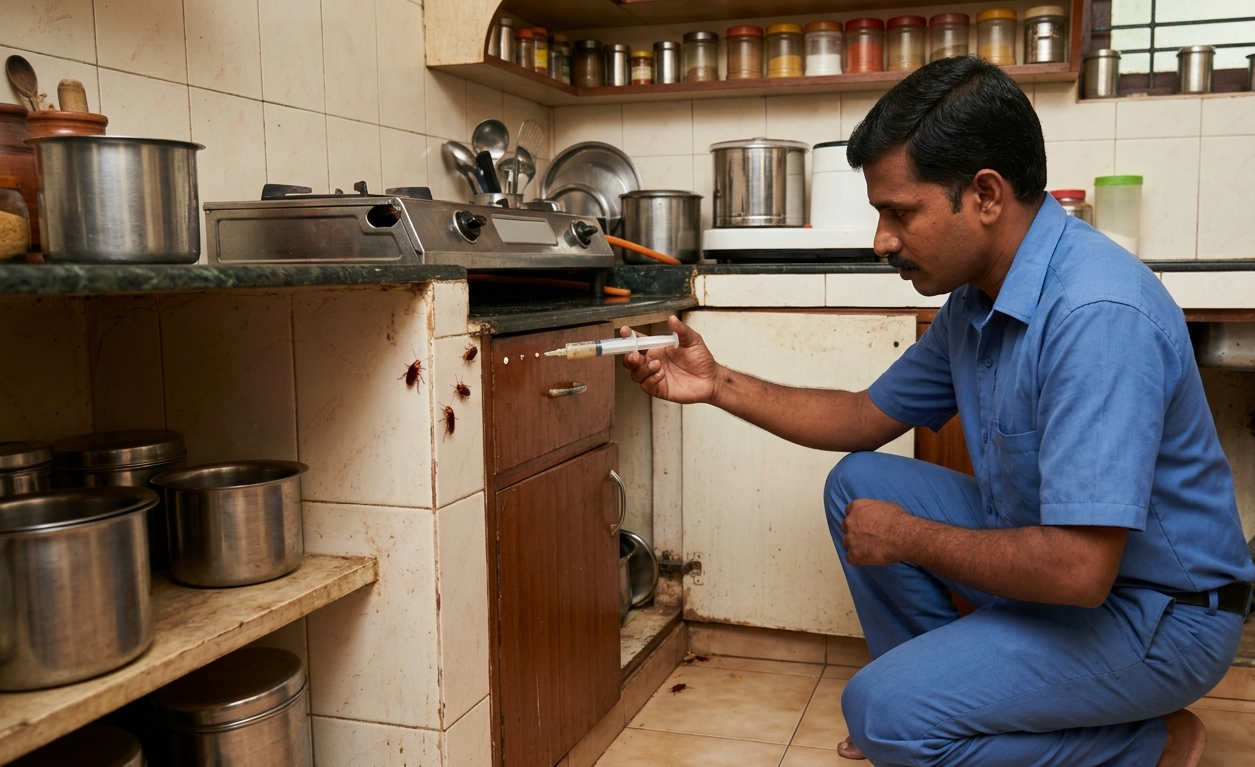
The small ones — 12 to 16 mm, light brown, two dark lines running back from the head, always inside the kitchen cupboard — are cockroaches, and those genuinely live inside the house. Different insect, different treatment, everything different. If that is what you are seeing, read our cockroach article instead, because nothing here will help you.
Most flats in Kazhakkoottam and Technopark side, and most newer houses, get cockroaches. Older independent houses with their own septic tank and open drainage get the cockroach ones. Plenty of places have both, from two completely unrelated causes, and end up getting treated for only one.
Four ways they are getting in
Go and check tonight. Ten minutes.
Start with the floor drains nobody uses. The guest bathroom. The upstairs bathroom in a house where only the ground floor is occupied. The drain behind the washing machine. Each of those has a water seal in it — a U-bend holding a little water — and that seal is the only thing standing between your bathroom and the sewer. Three weeks without water going into it and it dries up. Now the pipe is just an open corridor.
This is why locked-up houses are the worst cases we see. Half of our drainage calls in Thiruvananthapuram come from houses where the family is in the Gulf and only a caretaker comes once a week. Nobody runs water in the second bathroom for months together. By the time the family arrives for the holidays, every water seal in the house is dry and the place is full of cockroaches, and everyone blames the caretaker. It is not the caretaker.
Pour a mug of water into each one. If it gurgles and the smell changes, that seal was already gone.
Second, look at the gratings. Cracked plastic, rusted iron, any gap you could push a matchstick through. That is an entrance.
Third, run your fingers around the pipe where it goes through the wall — under the kitchen sink, behind the toilet, wherever the PVC waste crosses the masonry. Nine times out of ten the plumber left a gap and nobody has filled it in twenty years.
Fourth, the inspection chamber outside. Lift the slab at night with a torch. If you see movement, you have found your source and you can stop searching.
Those small fuzzy flies near the drain
Different insect, same root cause.
If there is a cluster of tiny moth-like flies sitting on the bathroom wall near the floor drain, those are drain flies. Not fruit flies, and nothing to do with your waste bin.
Here is the part that matters. They do not breed in the water. They breed in the slime. There is a gelatinous film of soap, hair, skin and bacteria coating the inside of the pipe just below the opening, and the larvae live in that film. Which explains why every home remedy fails.
Boiling water runs straight past it. Bleach runs past in about four seconds and never touches the film. Spraying the flies you can see finishes that batch, and the next lot comes out in two days.
The only thing that works is removing the film, physically or chemically. A proper drain treatment uses a foam that expands to fill the pipe and grips the vertical wall long enough to break the biofilm down. Bio-enzymatic products do the same job slower, and they are the better option if you are running a hotel or a bakery and want something you can put down every week without thinking.
But let me be straight with you. If the film has been building up for years, or if there is a sag in the line holding permanent sludge, foam alone will not be enough. Sometimes the pipe needs mechanical cleaning first. We will tell you that instead of selling you a treatment we know will not hold, because you will only call us back in one month, angry.
Rats come up the same way
This one gets missed constantly.
Rats swim. They will travel through a half-flooded line without difficulty, and a good-sized one gets through a gap of about 20 mm. In older properties around Karamana, Poojappura, Chalai side, where roots have got into the old clay or early PVC sewer pipe and cracked it, you effectively have a rat highway running from the road chamber into your compound.
So if there is scratching in the ceiling at night and cockroaches in the bathroom, do not treat those as two separate problems. Usually it is one.
What we actually do when we come
I am putting this here because most people have no idea what they are buying, and vagueness is exactly where poor work hides.
We start by mapping the drainage. Floor traps, gully traps, inspection chambers, septic tank, soak pit. In an ordinary three-bedroom house in the city that is usually eight to fourteen points, and about half the time the owner is surprised by at least one of them.
Then every trap gets checked for a live water seal. Dry ones are flagged and filled. If a trap is genuinely never going to be used, we will recommend a one-way drain valve or a sealed cover, because telling you to refill it every week for the rest of your life is not a plan.
Then the biofilm treatment. Foam injected into each line so it expands against the full circumference of the pipe and stays there long enough to do something.
Then the chambers, manholes and the ground around the septic tank get a residual treatment. CIB&RC registered products, label rates, applied by somebody licensed to apply them. Ask any company for that and watch how they answer.
Then the boring part that actually decides everything: sealing the gaps around pipe penetrations, flagging broken gratings, putting mesh over the vent pipe if it is open to the sky. Cheap, unglamorous, skipped by almost everybody.
Then we come back and check whether anything is still emerging at the treated points. If it is, the source is beyond your property line, and at that stage the honest advice is to take it to the Corporation or your Panchayat, because nothing we do inside your compound will fix a broken public line.
That last point deserves attention. If your neighbour’s chamber is the breeding site and yours is not, treating your house alone buys you a few weeks, not months. Get the lane or the flat association to do it together. It works far better and each house pays less. We do this regularly for apartment associations and it is always the cheaper route.
Five things that cost you nothing
Pour a mug of water into every unused floor drain once a week. Honestly, this one habit solves a good number of the calls we get.
Keep the chamber slabs properly seated and replace cracked ones.
Put mesh over the top of the soil vent pipe if it is open.
Once a month take a stiff bottle brush to the inside rim of your bathroom drains. You are breaking the film before it establishes.
And stop pouring cooking oil into the kitchen sink. That is the main feedstock for the whole thing.
When to stop trying and call somebody
If cockroaches are coming out of drains more than twice a week. If the drain flies are back within a week of cleaning. If there is a sewer smell that will not go, which means a broken seal or a cracked line somewhere. Or if you run a hotel, hostel, small restaurant, hospital or food unit, where being able to show a documented drain hygiene programme is not optional.
Call us and we will come and look for free. We cover Thiruvananthapuram city and the whole district, and we work across Kerala.
📞 Tel: 0471-2353735 | Mobile: 81138 50599 — call or WhatsApp.
Questions people ask
Why only at night? They are nocturnal and they avoid light. Most activity is in the two to four hours after full darkness. Seeing them in daylight means either a heavy population or something has disturbed the harbourage.
Will bleach in the drain kill the flies? No. It is gone in seconds and never touches the film where the larvae are. You need something that stays in contact.
How often should this be done? For a house, twice a year — once before the southwest monsoon arrives in June and once after the rains finish. Hotels and food units, monthly or quarterly depending on volume and whatever your FSSAI audit needs.
Is it safe for my septic tank? Depends what is used. Strong biocides can knock back the bacteria a septic system runs on. Tell whoever is treating you that you are on a septic tank, and if they do not have a proper answer to that, be careful.
Can it be done during the monsoon? Yes, but timing matters. Heavy inflow dilutes and flushes the treatment straight out. We work around the forecast and use formulations that hold better in wet conditions.
Will this finish it permanently? No, and anybody telling you otherwise is selling. There is a live sewer network next to your house and it is not going anywhere. What treatment does is break the current population, remove what they are breeding in, and shut the doors they are using. Do that, keep the water seals wet, and most houses stay quiet between visits.
PCCS India — drainage and sewer pest treatment across Thiruvananthapuram, Kollam, Kottayam, Ernakulam and all districts of Kerala.