
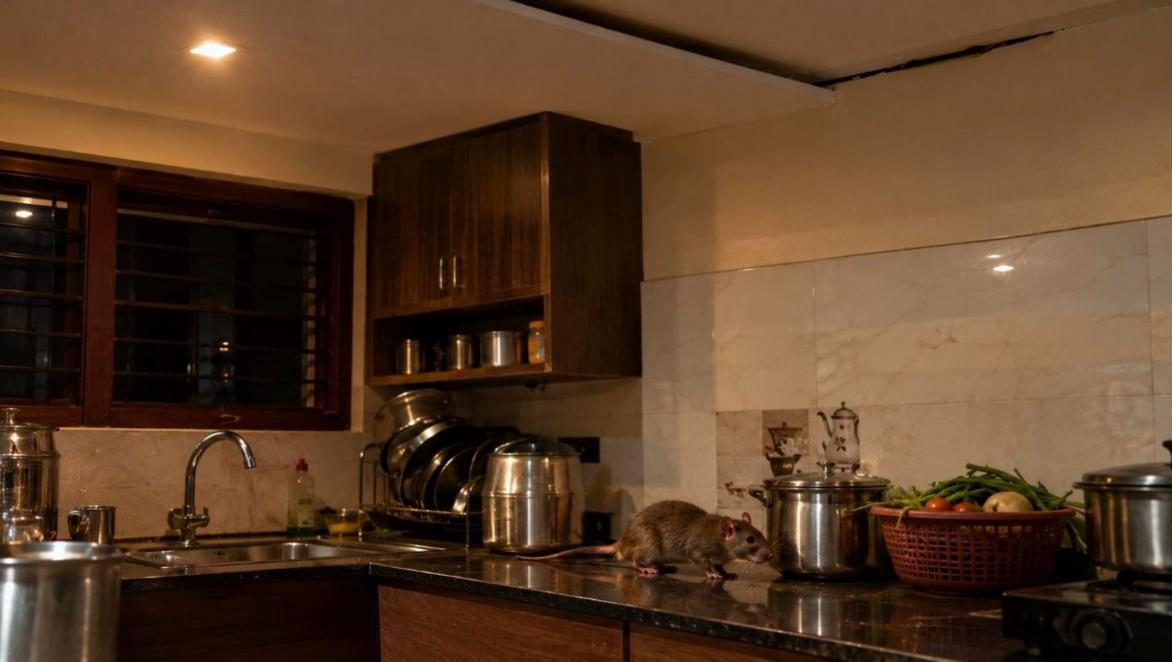
Most people who call us about rats open with the same line. “I think it’s just one.” Then they tell me about the noise above the bedroom at night, the inverter cable that got chewed, the droppings near the gas cylinder. That isn’t one rat.
I don’t say that to frighten anybody. It’s just how rodents work. A pair of house rats can turn into a few dozen within a year if the place gives them food and a dry corner, and most Kerala houses give them both. By the time you hear them every night, they’ve been living with you for a while.
Why the calls start in October
June to September, the drains overflow and the rats get flushed out of the low places. Then Thulavarsham comes, those heavy evening thunderstorms, and whatever was still living outside moves in looking for somewhere dry. In some areas the paddy gets harvested around now, so the field rats lose their cover as well. Late September till end of November, honestly, it’s the same three complaints on the phone again and again. Scratching up in the ceiling. Bananas on the dining table with bite marks. And a smell no one can trace.
The smell? Dead rat. Usually wedged in some wall gap, or gone behind the kitchen cupboard to die. And it almost always turns up a few days after someone put down poison cakes from the shop.
The trouble with poison cakes
I understand why people use them. They’re cheap, every shop sells them, and yes, they kill rats. The problem is where the rat dies. The rat eats it, fine, but it doesn’t die then and there. Three, four days it goes around feeling weak and thirsty, and then it goes and hides in the darkest hole it knows of. Got a gypsum false ceiling? Wooden attic? Then guess where that hole is. Now somebody has to cut the ceiling open to get it out.
The other thing is that the cakes kill some of them and fix nothing. Rats are wary of new food, so a few always survive, and the holes they used to come in are still open. A month later new ones walk in from the next compound and you’re back where you started.
And there’s the obvious one. I have seen bait cakes lying open under a sofa in a house with a two-year-old crawling around. Please don’t do that.
Rats here are a health problem, not just a nuisance
Everyone in Kerala knows eli pani. Rat fever is leptospirosis, and it comes from rat urine. It sits in water and wet mud and gets in through a small cut on the foot, or the eyes, or the mouth. Every rainy season the health department puts out the warnings again. Most of us think, ok, that’s for the paddy field people, or whoever walked through the flood. Not really. The rat that’s on your kitchen counter at 2 am, sipping from the sink outlet, is peeing as it goes. On the plate rack. On the vegetable basket kept on the floor.
Then there’s the wiring. Rats have to keep chewing to wear down their teeth, and cable insulation suits them fine. I’ve opened ceilings in Pattom and Kazhakkoottam where half the lighting circuit had bare copper showing. That’s a fire waiting to happen. Cars too. Ask anyone who parks under a tree what the service centre charged them for chewed wiring in the engine bay.
What we actually do on a rodent job
It isn’t complicated. It just has to be done properly, and in order.
First, a real inspection. I’m looking for droppings, for rub marks, and for how they’re getting in. Rub marks, if you haven’t seen them, are this dark oily line on the wall or pipe where the same rats keep brushing past every night. In most houses here the list is nearly the same: gaps around drain pipes where they go through the wall, the kitchen sink outlet, open roof eaves, the space between the tiles and the wall in older houses, broken ventilator mesh, and the gap under the back door.
Second, sealing. Steel wool and cement into the pipe gaps. New mesh for the ventilators. A rubber strip under the back door. Boring work. Nobody doing it themselves bothers with it, and that’s exactly why their rats come back.
Third, control inside. Could be locked bait boxes put where the kids and the dog can’t reach. Could be traps up in the ceiling. Usually a bit of both. The bait boxes are shut with a key, which means we know where every piece of bait is, and we open and check each one when we come back. If there’s a false ceiling, I tell the owner honestly that a smell is possible and we place things to keep that chance low.
Fourth, we come back. One visit and done? Doesn’t happen with rats. We see what’s been eaten, pull out any dead ones, and if they’re walking right past a box we move it.
Things you can do this week
- Don’t leave food waste in an open bin overnight, fish waste especially. Rats will come a long way for it.
- Those thenga and the firewood piled up against the kitchen wall? Move them out a bit, few feet is enough.
- Mango tree branch resting on the roof sheet, cut it. These fellows climb like anything and a lot of them come in from the top.
- Rice in a sack on the store room floor is basically an invitation. Steel dabba, or a thick plastic drum with a lid.
- No mesh on the bathroom floor trap? Get one put. It costs about as much as a cup of tea.
- Cleaning droppings, put gloves on, pour some disinfectant over them first, then wipe. Don’t sweep them dry, that just puts the dust in the air.
None of this will clear a rat problem that’s already settled in. It does make your house a less comfortable place for them, and it helps a treatment hold once it’s done.
Homes, shops and godowns
For a home it’s usually one treatment visit plus follow-ups. Restaurants, bakeries, rice godowns, hospitals and apartment complexes are different, because new rodents keep arriving from outside no matter what you do. For those we set up a monthly plan with a bait station map and a written service record. If you run a food business, the food safety inspector is going to ask to see that record anyway.
📞 Tel: 0471-2353735 | Mobile: 81138 50599 — free inspection anywhere in Thiruvananthapuram district.
Questions people ask
Do those plug-in ultrasonic repellers work?
Not for long, in my experience. Rats get used to the sound in a few days and carry on. I’ve pulled one out of a ceiling with droppings sitting right next to it.
So how long till they’re gone?
Activity usually drops a lot in the first week. Two to three weeks is normal to get a house clear, longer if the entry points can’t all be sealed in one go.
Is the bait safe around my kids and my dog?
We only use locked bait stations inside homes, placed out of reach. The bait can’t be shaken out. Nothing is left loose on the floor.
We live in a flat. Isn’t this the association’s job?
Partly. Rats move through shafts and service ducts, so treating one flat on its own often doesn’t last. We can do the single flat, but if three or four families on the same floor are seeing them, it’s worth asking the association to do the whole building.
PCCS India — rodent control for homes, flats, shops and godowns across Thiruvananthapuram and all Kerala districts.